

Water Softener Versus Filtration System: Which Does Your Home Need?
Choosing between a water softener versus filtration system depends on the water problems you’re trying to solve.
White scale on faucets, cloudy glassware, chlorine taste, orange staining, and sediment in fixtures can all indicate different water conditions.
But they do not necessarily require the same treatment.
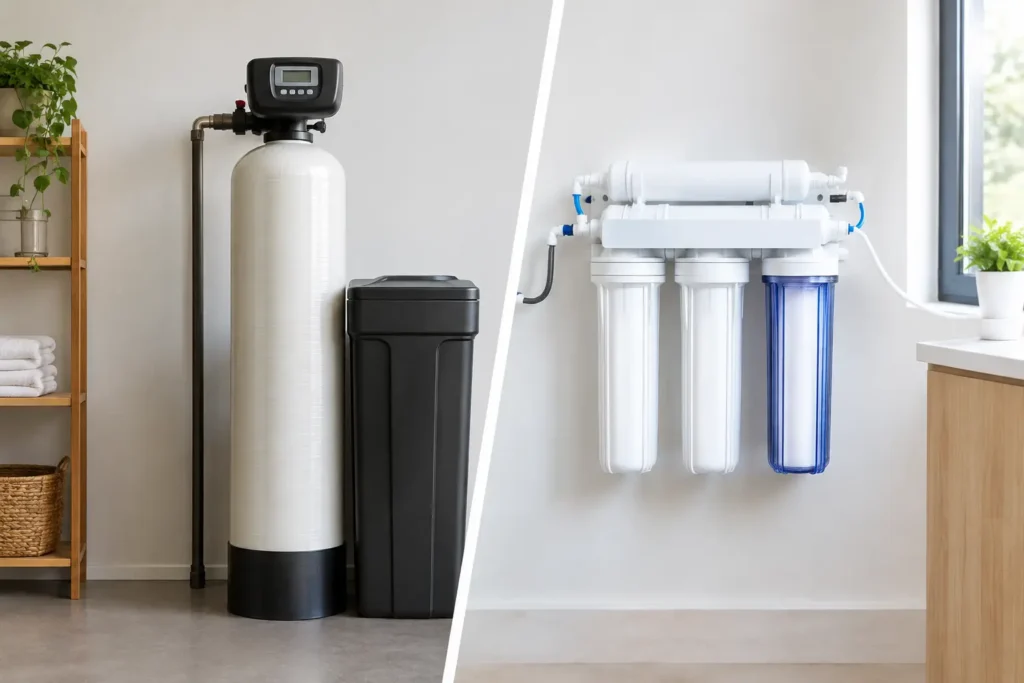
A water softener primarily removes hardness minerals. A filtration system is designed to reduce specific substances, such as sediment, chlorine, or other contaminants, depending on the equipment.
Some homes benefit from both systems. Others need only one, or a smaller drinking-water filter at a particular faucet.
For homeowners in Jacksonville, St. Johns County, Nocatee, Ponte Vedra, St. Augustine, and surrounding Northeast Florida communities, choosing the right equipment begins with understanding the water supply, household needs, and plumbing configuration.
Water Softener Versus Filtration System: What’s the Difference?
A water softener and a water filtration system perform different jobs.
What Does a Water Softener Do?
A conventional water softener removes dissolved calcium and magnesium, the minerals responsible for water hardness.
Most traditional salt-based softeners use ion exchange.
During this process, hardness minerals are exchanged for sodium or potassium ions.
The result is water with reduced hardness.
What Does a Water Filtration System Do?
A water filtration system uses selected media or treatment technology to reduce specific substances.
Depending on the equipment, filtration may address:
- Sediment
- Chlorine taste and odor
- Certain organic compounds
- Some metals
- Specific identified contaminants
- Certain odor-producing substances
Not every filter removes every substance.
The correct equipment depends on water testing and the manufacturer’s verified treatment capabilities.
Water Softener vs Water Filter: Quick Comparison
| Feature | Water softener | Water filtration system | |—|—|—| | Primary purpose | Reduce water hardness | Reduce targeted substances | | Removes calcium and magnesium hardness | Yes, with conventional ion exchange | Not with ordinary sediment or carbon filters | | Reduces chlorine taste | Not its primary function | Certain carbon filters can | | Captures sediment | Not its primary function | Yes, with appropriate sediment filtration | | Reduces hard-water scale | Yes | Only with suitable hardness treatment | | Improves drinking-water taste | Not necessarily | May, depending on the contaminant | | Requires maintenance | Yes | Yes | | Can serve the whole home | Yes | Yes | | Can be installed at one faucet | Uncommon | Yes |
The best system is the one designed to address the actual water condition.
1. Signs Your Home May Need a Water Softener
Hard water contains elevated levels of dissolved calcium and magnesium.
These minerals are common in water supplies and are not generally considered a health hazard at typical drinking-water levels.
However, they can affect plumbing fixtures, appliances, and cleaning performance.
White Scale on Faucets and Showerheads
A chalky white deposit around faucets and showerheads is a common sign of mineral buildup.
Scale may accumulate on:
- Faucet aerators
- Showerheads
- Shower doors
- Sink fixtures
- Appliance components
- Water-heating surfaces
Spots on Glassware
Hard water can leave mineral deposits after water evaporates.
However, spots may also involve detergent or other cleaning conditions.
Testing provides a more reliable answer than appearance alone.
Soap Scum and Cleaning Difficulty
Hardness minerals can react with soap, contributing to residue on surfaces and reduced cleaning efficiency.
Water Heater Scale
Mineral deposits can accumulate inside storage-tank water heaters and on heat-transfer surfaces.
Depending on the heater and severity, buildup may contribute to reduced performance or unusual heating noises.
Tankless Water Heater Maintenance
Tankless water heaters can be sensitive to scale accumulation within their heat exchangers.
Water hardness should be considered when evaluating maintenance requirements and manufacturer recommendations.
Learn more about water heater services.
2. What a Water Softener Will Not Fix
A water softener is not a universal water purification system.
It does not automatically solve:
- Chlorine taste or odor
- Sand or visible sediment
- Bacterial contamination
- Every dissolved chemical
- Rust caused by corroded plumbing
- A leaking water heater
- Deteriorated supply piping
- All sulfur-related odors
A softener may affect certain dissolved metals under specific conditions, but it should not be selected as a general iron-removal or contaminant-treatment solution without appropriate evaluation.
If the water suddenly changes color, develops an unusual odor, or contains visible particles, identify the source before purchasing equipment.
3. Signs Your Home May Need Water Filtration
Water filtration needs depend on the water source and the substance you want to reduce.
Chlorine Taste or Odor
Municipal water systems commonly use disinfectants to maintain water safety.
Some homeowners notice a chlorine taste or smell.
A properly selected carbon filter may reduce chlorine-related taste and odor.
Sediment in the Water
Sand, grit, or other suspended particles may collect in:
- Faucet aerators
- Fixture screens
- Appliance inlet screens
- Valves
- Filter housings
An appropriate sediment filter may help capture these particles.
However, the source of the sediment should also be considered.
Orange or Brown Staining
Orange staining may involve iron or corrosion-related conditions.
The appropriate solution depends on whether the problem originates in the water supply, water heater, or plumbing system.
Rotten-Egg Odor
Sulfur-like odors can have several possible causes.
These may involve water chemistry, microbial activity, or water heater conditions.
Not every carbon filter is designed to address every sulfur-related problem.
Drinking-Water Concerns
If the goal is to reduce a specific drinking-water contaminant, choose equipment certified or otherwise independently verified for that substance.
A filter’s appearance, size, or marketing description does not establish what it can remove.
4. Whole-House Filtration vs Under-Sink Filtration
Filtration systems are available in different configurations.
Whole-House Water Filtration
A whole-house system is generally installed where water enters the home’s plumbing distribution system.
Depending on the plumbing layout, it may treat water used by:
- Showers
- Bathroom faucets
- Kitchen fixtures
- Washing machines
- Water heaters
- Other connected fixtures
Whole-house filtration may be appropriate when the problem affects multiple areas of the home.
Under-Sink Water Filtration
An under-sink system treats water at a particular fixture.
It may be a practical choice when the primary concern is drinking-water taste or a specific contaminant at the kitchen sink.
Which Is Better?
Neither is automatically better.
A whole-house system treats a broader water supply, while a point-of-use system focuses on a specific location.
The correct choice depends on the treatment objective.
5. When Should You Install Both a Water Softener and Filtration System?
Some homes have more than one water-quality concern.
For example, a homeowner may want to reduce:
- Sediment
- Chlorine taste or odor
- Hardness minerals
A properly designed combination system may address these different conditions.
Example: Sediment, Carbon, and Softener
One possible arrangement includes:
- Sediment filtration when suspended particles are present
- Carbon filtration when appropriate for the treatment objective
- Water softening to reduce calcium and magnesium hardness
However, this is not a universal installation sequence.
The correct arrangement depends on water test results, equipment requirements, flow rates, and manufacturer instructions.
Why Equipment Order Matters
Sediment can interfere with treatment valves and other equipment.
Certain disinfectants can affect the service life of some softener components.
Incorrect equipment selection or arrangement may reduce system performance.
Does Every Home Need Both?
No.
Installing multiple systems without identifying the water problem can increase maintenance, take up space, and add unnecessary complexity.
6. Water Softener vs Salt-Free Water Conditioner
A salt-free conditioner is not the same as a conventional ion-exchange softener.
Traditional Salt-Based Softener
A conventional softener removes calcium and magnesium hardness through ion exchange.
Salt-Free Conditioner
Certain salt-free systems are designed to influence how hardness minerals form or adhere as scale.
They generally do not remove calcium and magnesium from the water in the same way.
Performance varies by technology and water conditions.
Which Should You Choose?
If your goal is measurable hardness reduction, a conventional softener may be appropriate.
If you’re considering scale-conditioning technology, review the manufacturer’s verified performance claims and limitations.
Do not assume the two technologies provide identical results.
7. How Water Testing Helps You Choose
Water testing is one of the most important steps before selecting treatment equipment.
Different complaints require different tests.
Hardness Testing
A hardness test measures calcium and magnesium hardness, commonly reported in grains per gallon or milligrams per liter as calcium carbonate.
Chlorine Testing
Chlorine testing may help evaluate disinfectant levels where relevant.
Iron and Manganese Testing
These tests may be useful when staining or discoloration is present.
Private Well Testing
Private well water may require broader testing based on local conditions and the property’s history.
For drinking-water safety concerns, testing should be performed through an appropriate qualified laboratory.
Why Symptoms Alone Are Not Enough
White residue, discoloration, or odor may have several causes.
Testing helps avoid purchasing equipment that cannot solve the problem.
8. How to Size a Water Softener Properly
Water softener sizing should reflect the household’s water demand and actual hardness level.
Important factors include:
- Number of occupants
- Water hardness
- Average water consumption
- Peak flow demand
- Equipment capacity
- Regeneration frequency
- Manufacturer specifications
What Happens if a Softener Is Too Small?
An undersized softener may not provide adequate capacity or flow for the household.
What Happens if a Softener Is Too Large?
Improperly selected or programmed equipment may operate inefficiently.
Proper sizing and setup matter more than simply purchasing the largest available unit.
9. How to Size a Whole-House Filtration System
A whole-house filter must accommodate the home’s water demand.
Flow Rate
The system should provide adequate flow when multiple fixtures operate.
Pressure Loss
Filters create some resistance to water flow.
An undersized or clogged filter may contribute to reduced pressure.
Media Selection
The filtration media must match the substance being targeted.
Service Life
Cartridges and media have replacement or maintenance requirements.
Access
The installation should allow future maintenance without unnecessary disruption.
If you’re already experiencing weak water flow, learn more about water pressure problems.
10. Water Softener and Filtration Installation Requirements
The plumbing layout matters as much as the equipment.
Before installation, the following should be evaluated.
Existing Water Softener Loop
Some homes have a dedicated water treatment loop or stub-out connections.
However, exposed piping near a water heater does not automatically confirm that a proper treatment loop exists.
The connections and water flow path should be verified.
Bypass Valves
A serviceable bypass can allow treatment equipment to be isolated when appropriate.
Regeneration Drain
Conventional salt-based softeners require a suitable discharge arrangement.
The drain must comply with applicable plumbing requirements and manufacturer instructions, including appropriate backflow protection.
Filter Maintenance Access
Filter housings need sufficient clearance for servicing.
Pipe Support and Connections
Water treatment equipment should be connected using suitable materials and properly supported piping.
Equipment Location
Available space, drainage, power requirements, and exposure to physical damage should be considered.
Outdoor Water Connections
Depending on the plumbing arrangement, some outdoor water connections may be bypassed to avoid unnecessary treatment.
The correct configuration depends on the home’s layout and the homeowner’s objectives.
11. Water Softener and Filtration Maintenance
Water treatment equipment is not maintenance-free.
Water Softener Maintenance
Depending on the model, maintenance may involve:
- Salt replenishment
- Checking regeneration operation
- Inspecting drain connections
- Monitoring for leaks
- Reviewing equipment settings
Filtration Maintenance
Depending on the system, maintenance may involve:
- Cartridge replacement
- Media servicing or replacement
- Checking pressure changes
- Inspecting filter housings
- Monitoring water quality
- Following manufacturer sanitation procedures
Neglected equipment may stop performing properly.
Why Drain Connections Matter
Water softener regeneration discharges water through a drain connection.
An improper discharge arrangement can create leakage, overflow, or contamination concerns.
The drain should be evaluated during installation.
12. Can Water Treatment Help Protect Water Heaters and Fixtures?
Appropriate water treatment may help reduce certain conditions that contribute to mineral buildup.
Faucets and Showerheads
Reducing hardness may decrease scale accumulation on fixtures.
Conventional Water Heaters
Hardness reduction may help limit mineral scale formation.
Tankless Water Heaters
Managing hardness may reduce scale-related maintenance concerns.
Appliance Connections
Filtration may help reduce sediment entering certain water-using appliances.
However, treatment equipment does not repair worn valves, leaking connections, corroded piping, or defective appliances.
The underlying plumbing still needs to be maintained.
13. How Much Does a Water Softener or Filtration System Cost?
Cost depends on the equipment and installation requirements.
Factors include:
- Treatment technology
- Equipment capacity
- Water test results
- Existing plumbing connections
- Installation location
- Drain requirements
- Bypass configuration
- Pipe modifications
- Available space
- Ongoing maintenance
A single under-sink drinking-water filter is a different project from installing whole-house filtration and softening equipment.
Homeowners should consider long-term maintenance as well as installation requirements.
14. Water Treatment Considerations for Northeast Florida Homes
Water conditions vary by source and location.
Homes in Jacksonville, St. Johns County, Nocatee, Ponte Vedra, and St. Augustine may receive water from different utility systems or private wells.
Municipal Water
Municipal water may contain disinfectants and naturally occurring minerals.
Actual hardness and treatment conditions vary.
Private Well Water
Private wells can have different treatment concerns, including sediment, metals, odor, and microbiological risks.
Appropriate testing is particularly important.
New Construction
Newer homes may already have water treatment connections or space designated for equipment.
However, the existing piping should be verified before installation.
Existing Homes
Older properties may require piping modifications, new valves, or an appropriate drain connection.
The installation plan should reflect the actual plumbing system.
Frequently Asked Questions About Water Softeners and Filtration
Is a water softener better than a water filtration system?
Neither is universally better. A softener addresses hardness, while filtration targets specific substances.
Do I need a water softener if I have a whole-house filter?
Possibly. Most ordinary sediment and carbon filters do not remove hardness minerals.
Can a water filter soften hard water?
Most conventional filters cannot. Certain specialized treatment technologies can reduce hardness, but the equipment must be selected for that purpose.
Does a water softener remove chlorine?
A conventional ion-exchange softener is not designed primarily for chlorine removal.
Can I install a water softener and filter together?
Yes, when the equipment is compatible and properly configured.
Does a water softener help with white scale?
A conventional softener reduces hardness minerals that contribute to scale.
Will a water softener remove iron?
Some softeners may remove limited amounts of certain forms of iron under suitable conditions, but they should not automatically be used as general iron-treatment equipment.
Is softened water safe to drink?
Softened water is not automatically unsafe, but ion-exchange softening can increase sodium or potassium content. Households with specific dietary or medical restrictions should seek appropriate guidance.
Does a whole-house filter remove bacteria?
Only systems specifically designed and verified for microbiological treatment should be relied upon for that purpose. Ordinary sediment and carbon filters are not substitutes for appropriate disinfection.
Is reverse osmosis the same as a water softener?
No. Reverse osmosis uses a membrane process to reduce certain dissolved substances, while a conventional softener uses ion exchange to reduce hardness.
Can water treatment improve water pressure?
Treatment equipment does not generally correct the underlying causes of low water pressure. An improperly sized or clogged system can actually reduce flow.
How do I know which system my home needs?
Start with the symptoms, identify the water source, obtain appropriate testing, and select equipment designed for the actual treatment goal.
Water Softener and Filtration Installation in Jacksonville and St. Johns County
The right water treatment system should address a confirmed water condition while fitting the home’s plumbing layout and water demand.
Kingdom Based Plumbing Inc. helps homeowners throughout Jacksonville, St. Johns County, Nocatee, Ponte Vedra, St. Augustine, and surrounding Northeast Florida communities with plumbing-related water treatment installation needs.
Whether you’re considering a customer-supplied water softener, a whole-home filtration system, or both, KBP can evaluate the existing plumbing connections, installation requirements, and appropriate scope of work.
Water testing, specialized treatment design, equipment programming, and manufacturer-specific service should be confirmed separately rather than assumed to be included with plumbing installation.
Call Kingdom Based Plumbing at 904-814-8541 to discuss your water softener or filtration installation.
Clean work. Proper installation. No shortcuts.