

Before You Spend a Dollar, Read This
Few household expenses catch homeowners off guard quite like a failing water heater. One day everything works exactly as it should. The next morning, you’re standing in a cold shower wondering what happened—and more importantly—how much it’s going to cost to fix.
For most families, replacing a water heater isn’t something they’ve researched before. In fact, many homeowners won’t replace one more than once or twice during the time they own their home. That’s exactly why this guide exists. Not to sell you a water heater. Not to convince you that you need one. But to help you understand exactly what you’re looking at before you spend thousands of dollars.
If you’ve already started requesting estimates, you’ve probably noticed something confusing. One company gives you one price. Another company gives you a completely different price. Maybe both companies recommend the same size water heater.
Maybe they’re even quoting the same manufacturer. So why aren’t the estimates even close? That’s one of the questions we answer almost every week. The answer usually has very little to do with the water heater itself.
And that’s exactly where most homeowners get frustrated.
A Conversation We Have Almost Every Day
One of the first questions we hear when we arrive is:
“Can you just tell me how much it’s going to cost?”
We understand why people ask. Nobody likes surprises. If your refrigerator breaks, you can usually look up the replacement price online. If your washing machine stops working, there are dozens of websites showing average costs.
Water heaters seem like they should be the same. Unfortunately…they’re not.
Because replacing a water heater isn’t just about replacing a water heater; it’s about replacing your water heater. Inside your home. Connected to your plumbing system. Installed in your location.
Every one of those details matters.
Why This Guide Is Different
There are thousands of articles online explaining water heaters.
Most of them were written by national companies.
Some were written by marketing agencies.
Many were written by people who’ve probably never carried a water heater through a narrow hallway, climbed into an attic during a Florida summer, or spent an afternoon helping a homeowner understand why two estimates are so different.
This guide is different.
It’s written from the perspective of plumbers who work in Northeast Florida every day.
The homes here are different.
The neighborhoods are different.
The plumbing systems are different.
Even where water heaters are installed can vary dramatically depending on when and where the home was built.
A newer home in SilverLeaf may have a completely different utility layout than an older home in Jacksonville.
A home in Ponte Vedra Beach may present different installation challenges than a house in World Golf Village.
A family in Nocatee may use twice as much hot water as a retired couple living just a few miles away.
Those differences matter.
And they affect far more than most homeowners realize.
What We’ve Learned After Replacing Thousands of Water Heaters
One thing surprises us more than anything else.
Most homeowners think they’re buying a water heater.
In reality…
they’re hiring someone to solve a plumbing problem.
Those are two very different things.
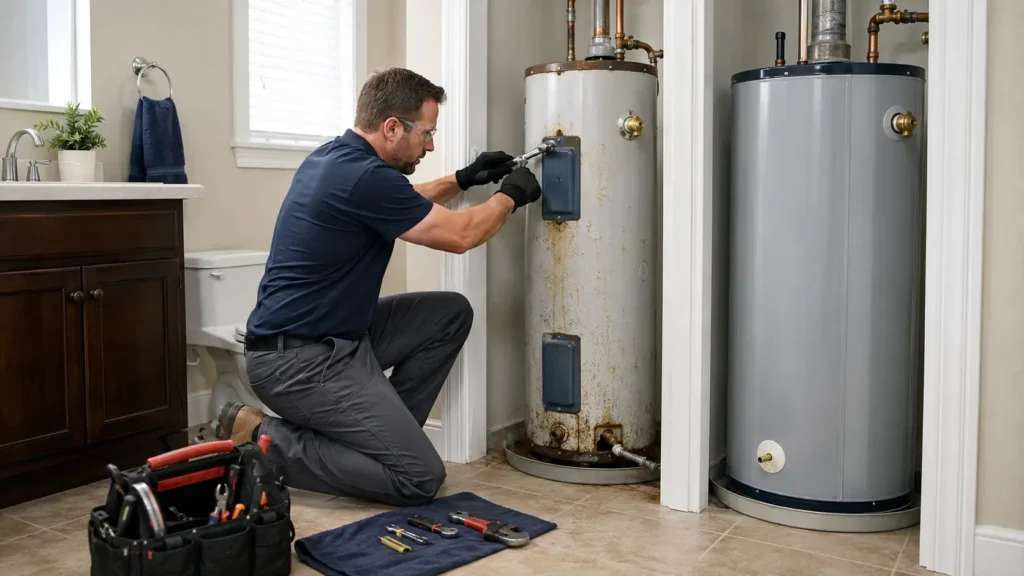
The water heater sitting in your garage, attic, utility room, or hallway closet is only one piece of the project.
Everything connected to it matters just as much.
The condition of your plumbing.
The age of the shutoff valves.
The accessibility of the installation.
The layout of the home.
The type of equipment being installed.
Even something as simple as moving a 50-gallon water heater through a finished home without damaging walls or flooring requires planning and experience.
That’s why two homes with the exact same water heater can require two completely different scopes of work.
KBP Insight
One of the biggest misconceptions we see is homeowners comparing estimates based only on the total price.
That’s understandable.
It’s also one of the easiest ways to make the wrong decision.
A lower estimate isn’t automatically a better value.
A higher estimate isn’t automatically overpriced.
The real question isn’t:
“Which estimate costs less?”
The better question is:
“What am I actually getting for my investment?”
By the end of this guide, you’ll know exactly how to answer that question.
Northeast Florida Isn’t Like Every Other Market
One reason national articles often fall short is that they try to apply the same advice to every homeowner in the country.
That’s not how plumbing works.
Throughout Jacksonville, St. Johns County, Ponte Vedra, Nocatee, St. Augustine, Fleming Island, Fruit Cove, and the surrounding communities, we work on homes built across many different decades and neighborhoods.
Some water heaters are installed in open garages where access is simple.
Others are tucked into hallway closets with just enough room to slide the old tank out.
Many newer two-story homes place the water heater upstairs or in attic utility spaces, requiring extra care to safely remove and install equipment without damaging finished living areas below.
We’ve worked in homes where replacing the water heater was straightforward.
We’ve also worked in homes where the water heater itself wasn’t the challenge—it was everything around it.
That’s why there isn’t a universal replacement price that applies to every home.
What This Guide Will Teach You
Our goal is simple.
By the time you finish reading, you’ll understand:
- Why water heater replacement costs vary from one home to another.
- What factors actually affect the total investment.
- Why two plumbers can recommend different solutions.
- When repairing a water heater makes sense.
- When replacement is usually the better long-term investment.
- How long water heaters typically last in Northeast Florida.
- How to choose the right size and type of water heater for your family.
- How to compare plumbing estimates with confidence.
- The questions every homeowner should ask before hiring a plumbing company.
Most importantly…
You’ll understand why those answers apply to your home—not just homes in general.
Our Promise to You
Whether Kingdom Based Plumbing is the company you choose or not, we believe every homeowner deserves honest, straightforward information before making a major plumbing decision.
If replacing your water heater truly is the right choice, we want you to understand why.
If repairing it makes more sense, we’ll explain that too.
Because our job isn’t simply to install plumbing.
Our job is to help homeowners make informed decisions with confidence.
That’s the purpose of this guide.
And now that we’ve covered the foundation, let’s answer the question that brought you here in the first place:
How Much Does It Actually Cost to Replace a Water Heater in Jacksonville and Northeast Florida?
So…How Much Does It Cost to Replace a Water Heater in Jacksonville & Northeast Florida?
If you’re hoping for one simple number, we completely understand.
In fact, it’s probably the very reason you found this guide.
The honest answer is that there isn’t one price that fits every home.
That may sound frustrating at first, but by the end of this section you’ll understand why it’s actually good news.
A professional plumber shouldn’t quote your water heater replacement the same way someone prices a microwave or refrigerator.
A water heater replacement isn’t simply purchasing a new appliance.
It’s evaluating an entire plumbing system and designing the best solution for your specific home.
That’s why two neighbors can own similar homes, replace similar water heaters, and still receive very different estimates.
Why You Won’t Find One Honest Price Online
Search online and you’ll see dozens of articles claiming they know exactly what your replacement should cost.
Some list national averages.
Others publish state averages.
Some even promise to tell you the exact cost before anyone has looked at your home.
The problem?
None of those websites have seen your water heater.
They don’t know:
- Where it’s installed.
- How old the plumbing connections are.
- Whether your family needs more hot water than they did ten years ago.
- Whether the existing installation is in excellent condition or ready for additional work.
Without seeing those things, any number is simply an estimate based on assumptions.
We don’t believe that’s the best way to help homeowners make an informed decision.
What Actually Determines the Price?
Instead of asking,
“How much does a water heater cost?”
a better question is:
“What will it take to replace the water heater in my home correctly?”
That’s the question we answer during every evaluation.
Some of the biggest factors include:
- The type of water heater being installed.
- The size of the water heater.
- Whether it’s electric, natural gas, propane, hybrid, or tankless.
- The location of the installation.
- Accessibility.
- The condition of the existing plumbing.
- The materials required to complete the installation.
- Your family’s current and future hot water needs.
Every one of these factors influences the overall project.
A Real Example
Imagine two homeowners.
Both need a new 50-gallon electric water heater.
On paper, the jobs sound identical.
But here’s the reality.
Home One
- A single-story home in Fruit Cove.
- The water heater is located in an open garage.
- There is excellent access.
- The plumbing connections are in good condition.
- The installation proceeds smoothly.
Home Two
- A two-story home in Nocatee.
- The water heater is located in an upstairs utility closet.
- The hallway is narrow.
- Finished flooring needs protection.
- The existing plumbing requires additional work before the new water heater can be installed.
Same size water heater.
Different home.
Different scope of work.
Different amount of labor.
Different investment.
That’s why comparing only the final number rarely tells the whole story.
KBP Insight
One thing we’ve learned after replacing water heaters throughout Northeast Florida is this:
The water heater itself is often the easiest part of the project.
It’s everything around it that determines how straightforward—or how involved—the replacement becomes.
That’s something homeowners don’t usually discover until a plumber takes the time to explain it.
Why Estimates Can Vary So Much
One homeowner might receive three estimates that are all within a few hundred dollars.
Another homeowner may receive estimates that differ by well over a thousand dollars.
That doesn’t automatically mean one company is wrong.
It means you need to understand what each company is including.
For example:
One estimate may include replacing aging shutoff valves and supply connectors because they’re already showing signs of wear.
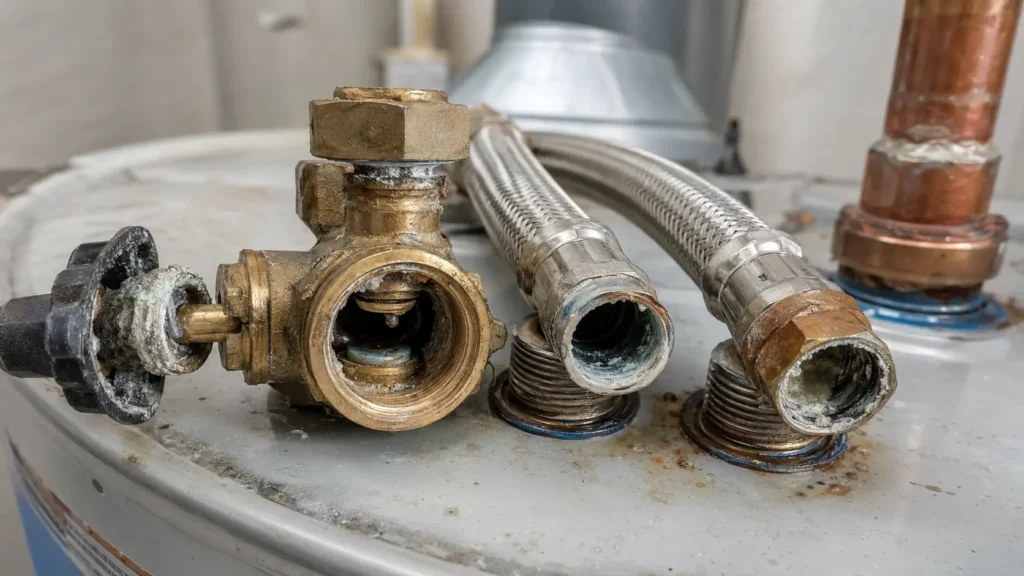
Another company may recommend reusing those same components.
One plumber may recommend replacing additional materials now while everything is disconnected.
Another may suggest waiting until they fail.
Neither approach is automatically right or wrong.
What’s important is understanding the reasoning behind each recommendation.
A good plumbing company should never expect you to approve work simply because they say so.
They should explain what they see, why they’re recommending it, and answer every question you have before work begins.
What You’re Really Paying For
Many homeowners believe they’re paying for a new water heater.
In reality, you’re investing in much more than that.
You’re investing in:
- Professional evaluation.
- Safe removal of the existing unit.
- Proper installation.
- Quality workmanship.
- Reliable plumbing connections.
- Thorough testing.
- Clean-up after the work is complete.
- Confidence that your hot water system is ready for daily use.
The water heater is certainly an important part of the project.
But the installation is what determines how that water heater performs for years to come.
Should You Choose the Lowest Estimate?
Every homeowner wants a fair price.
So do we.
But the lowest estimate isn’t always the best value.
Instead of asking,
“Which plumber is the cheapest?”
consider asking:
- What exactly is included?
- What isn’t included?
- What recommendations are optional?
- Why are they recommending additional work?
- What happens if something unexpected is found?
- Will they explain everything before moving forward?
Those answers often tell you far more than the total price at the bottom of the estimate.
Another Question We Hear Almost Every Day
Once homeowners understand why pricing varies, another question almost always follows.
It’s one of the smartest questions you can ask.
“Do I actually need to replace my water heater…or can it be repaired?”
Sometimes a repair is all that’s needed.
Other times, replacing the unit is the better long-term investment.
The challenge is knowing the difference.
In the next section, we’ll explain how experienced plumbers evaluate that decision, the warning signs homeowners should watch for, and how to determine which option makes the most financial sense for your specific situation.
Should You Repair Your Water Heater or Replace It?
If there’s one question homeowners struggle with the most, it’s this:
“Do I really need a new water heater?”
It’s a fair question.
Replacing a water heater is a significant investment, and no homeowner wants to spend thousands of dollars if a repair could safely restore hot water and provide several more years of reliable service.
The good news is this:
Not every water heater problem means you need a new water heater.
In fact, many issues we diagnose every week can be repaired.
The challenge is determining when a repair makes sense—and when continuing to invest in an aging water heater simply delays the inevitable.
That’s where experience matters.
Our Philosophy at Kingdom Based Plumbing
One thing you’ll notice if you work with our team is that we don’t believe every service call should end with a replacement.
Sometimes repairing the existing water heater is absolutely the right recommendation.
Other times, we’d rather tell a homeowner to replace the unit than spend their money on a repair that only buys a little more time.
Our goal isn’t to sell equipment.
Our goal is to help you make the smartest financial decision for your home.
Sometimes that means repairing.
Sometimes that means replacing.
Every recommendation starts with understanding your situation.
When a Repair Often Makes Sense
Many water heater problems involve individual components rather than the storage tank itself.
If the tank is still structurally sound and the overall condition of the unit is good, replacing one worn component may restore reliable operation.
Examples include:
- Heating elements
- Thermostats
- Temperature and pressure relief valves
- Pilot light issues
- Ignition components
- Thermocouples
- Drain valves
- Minor plumbing connection leaks
- Certain electrical components
These repairs are often far less expensive than replacing the entire water heater.
If the rest of the unit is in good condition, repairing it may provide excellent value.
KBP Insight
We’ve had homeowners apologize before we even start the evaluation.
They’ll say something like,
“I know it’s probably shot.”
Then we inspect the water heater and discover a single failed component.
Instead of replacing the entire system, we’re able to repair it and restore hot water.
Those are some of our favorite service calls because we know we helped someone avoid an unnecessary expense.
Just as importantly, we’ve had the opposite happen too.
A homeowner hopes for a small repair, but after evaluating the system we discover the storage tank itself has failed.
In those situations, honesty matters just as much.
When Replacement Is Usually the Better Investment
There comes a point where continuing to repair an older water heater stops making financial sense.
The biggest factor isn’t necessarily age.
It’s condition.
Some of the situations where replacement often becomes the better long-term investment include:
- Water leaking from the storage tank itself.
- Significant corrosion.
- Multiple components beginning to fail.
- Repeated repair calls over a short period of time.
- Declining heating performance combined with increasing repair costs.
Once the tank itself begins leaking, replacement is almost always the safest and most practical solution.
Unfortunately, unlike many individual components, the storage tank itself isn’t designed to be repaired.
Age Doesn’t Tell the Whole Story
One of the biggest myths in our industry is that every water heater should automatically be replaced after a certain number of years.
The reality is much more complicated.
We’ve seen older water heaters continue performing well because they’ve been properly maintained.
We’ve also seen relatively newer units experience problems much sooner due to water conditions, heavy household demand, or previous installation issues.
Age is certainly something we consider.
But it’s only one piece of the puzzle.
If someone tells you a water heater must be replaced simply because it reached a certain birthday, they’re probably oversimplifying the decision.
Think About It Like Your Vehicle
Imagine owning a truck with 180,000 miles.
Would you replace it simply because of the mileage?
Probably not.
You’d look at the overall condition.
- Does it run well?
- Has it been maintained?
- Is it dependable?
- Would the repair you’re considering provide several more years of reliable service?
Water heaters deserve the same type of evaluation.
The goal isn’t to replace equipment because of a number.
The goal is to determine whether investing more money into the existing system still makes sense.
Sometimes the Cheapest Decision Becomes the Most Expensive
Let’s say a repair costs several hundred dollars.
Replacing the water heater costs considerably more.
Naturally, most homeowners lean toward the repair.
Sometimes that’s absolutely the right choice.
But imagine this.
You approve the repair.
Everything works well.
Three months later, the storage tank begins leaking.
Now you’ve paid for the repair…
and you’re still replacing the water heater.
That’s why we always encourage homeowners to look beyond today’s invoice.
Sometimes spending less today actually costs more over the next year or two.
The opposite can also be true.
If a repair is inexpensive and the rest of the water heater is in excellent condition, repairing it may be the smartest financial decision you can make.
There isn’t a universal answer.
That’s why every evaluation should be based on the specific condition of your water heater.
Questions We Ask Before Making a Recommendation
When we evaluate a water heater, we’re not looking at just one thing.
We’re looking at the complete picture.
Some of the questions running through our minds include:
- What’s actually causing the problem?
- Is the storage tank still in good condition?
- Is this an isolated failure or the beginning of several?
- Has the homeowner experienced previous repairs?
- Does repairing the unit provide reasonable long-term value?
- Would replacing it provide greater peace of mind?
- What makes the most financial sense for this homeowner?
Those answers help us make recommendations that are based on facts rather than assumptions.
A Real Northeast Florida Example
Imagine two homeowners call us on the same day.
The first homeowner lives in Ponte Vedra.
Their electric water heater has stopped producing hot water because a heating element has failed.
The storage tank is in excellent condition.
A repair restores the system, and they avoid the cost of a replacement.
Later that afternoon, we visit a homeowner in St. Augustine.
Their complaint sounds almost identical.
“No hot water.”
After evaluating the system, we discover water leaking directly from the storage tank.
Although both homeowners experienced the same symptom, the appropriate recommendation is completely different.
That’s why diagnosing the cause always comes before discussing the solution.
The Best Decision Is an Informed Decision
A trustworthy plumber shouldn’t make the decision for you.
They should give you the information you need to make the decision yourself.
That means explaining:
- What’s wrong.
- Why it happened.
- What can be repaired.
- What can’t.
- What each option will likely cost over time.
- The advantages and disadvantages of each approach.
When homeowners understand their options, they almost always make good decisions.
Our job is simply to give you the information to do that confidently.
One More Question Naturally Comes Next…
Once homeowners decide whether to repair or replace their water heater, another question almost always comes up.
“If I do replace it…how long should the next one last?”
That’s a great question.
And surprisingly…
there isn’t one answer.
In the next chapter, we’ll talk about what actually determines the lifespan of a water heater in Northeast Florida, the warning signs homeowners should watch for, how water quality affects longevity, and what you can do to get the maximum life out of your investment.
How Long Does a Water Heater Last in Northeast Florida?
One of the first questions homeowners ask after replacing a water heater is:
“How long should this one last?”
It’s a great question.
Unfortunately, it’s also one of the most misunderstood.
You’ve probably seen articles online that say something like:
“A water heater lasts 8–12 years.”
Or…
“Expect 10–15 years.”
While those numbers aren’t necessarily wrong, they’re also not the complete story.
The truth is that water heaters don’t fail because they reach a certain birthday.
They wear differently depending on how they’re used, how they’re maintained, the quality of the installation, and the conditions inside the home.
That’s why two water heaters installed on the same day can have very different lifespans.
There Isn’t a Magic Number
If you’ve been told your water heater “has reached the age where it needs to be replaced,” take a step back and ask another question.
“Based on what?”
Age should absolutely be part of the conversation.
It should never be the entire conversation.
Think about two identical pickup trucks purchased on the same day.
One is driven 5,000 miles a year.
The other is driven 35,000 miles a year while towing a trailer every weekend.
Ten years later, would you expect them to be in identical condition?
Probably not.
Water heaters are no different.
The calendar tells part of the story.
The condition tells the rest.
What Actually Determines How Long a Water Heater Lasts?
There isn’t one answer.
Instead, several factors work together over time.
Some you can control.
Some you can’t.
Understanding them helps homeowners protect their investment and often extend the life of their next water heater.
Water Quality
One of the biggest influences on water heater longevity is the quality of the water flowing through your home.
Throughout Northeast Florida, we see a wide variety of water conditions depending on where the home is located and whether the home has any type of water treatment system.
Over time, naturally occurring minerals can settle inside the bottom of a storage tank.
As that sediment builds up, the water heater has to work harder to heat the water above it.
Homeowners sometimes notice this before they see it.
They’ll hear popping, cracking, or rumbling noises coming from the tank.
Those sounds are often caused by water working its way through layers of accumulated sediment during the heating process.
That doesn’t automatically mean the water heater needs to be replaced.
But it is one of the reasons routine maintenance can play such an important role in extending the life of the system.
KBP Insight
One thing we’ve noticed over the years is that two neighboring homes can have very different water heater histories.
One homeowner may have experienced very few plumbing issues over the life of their water heater.
The house next door may have dealt with mineral buildup, shortened fixture life, or repeated maintenance concerns.
Every home’s plumbing system tells a slightly different story, which is why evaluating the actual condition of the equipment is always more valuable than relying on age alone.
Daily Demand Makes a Difference
Your family’s lifestyle has a tremendous impact on how often your water heater operates.
Think about the difference between these two households.
- A retired couple living in Ponte Vedra.
- One morning shower.
- Occasional laundry.
- Minimal daily hot water use.
Now compare that to a family of six in St. Johns County.
- Three teenagers.
- Morning showers back-to-back.
- Dishwasher.
- Laundry.
- Evening baths.
The second water heater cycles far more frequently every single day.
More demand doesn’t automatically mean the water heater will fail early.
But like any appliance, increased use naturally results in increased wear over time.
That’s one reason choosing the proper size is so important.
Installation Quality Matters More Than Most People Realize
Most homeowners focus on the brand of water heater they’re purchasing.
That’s understandable.
But here’s something we’ve learned after replacing water heaters throughout Northeast Florida:
A quality installation is just as important as a quality water heater.
Even the best equipment depends on proper installation.
- Accurate plumbing connections.
- Careful workmanship.
- Thorough testing.
- Attention to detail.
Those are the things homeowners rarely see after the installation is complete.
But they’re often the things that contribute to long-term reliability.
Buying an excellent water heater and having it installed poorly is a little like buying premium tires and mounting them incorrectly.
The equipment matters.
The installation matters just as much.
Maintenance Isn’t Just for Air Conditioners
Many homeowners schedule annual HVAC maintenance.
Very few think about their water heater.
That’s understandable.
After all, it’s usually sitting quietly in the garage or utility room doing its job every day.
Out of sight.
Out of mind.
Until something goes wrong.
Periodic inspections allow small concerns to be identified before they become expensive problems.
Sometimes it’s simply catching a small leak before it becomes a larger one.
Other times it’s identifying a worn component before it fails unexpectedly.
Routine maintenance doesn’t guarantee a water heater will last forever.
But it often improves reliability and gives homeowners a much better understanding of the condition of their equipment.
Warning Signs You Shouldn’t Ignore
Most water heaters give homeowners clues before they fail completely.
Recognizing those warning signs early gives you more options.
Some of the most common include:
- Your hot water doesn’t last as long as it once did.
- Water takes longer to heat than it used to.
- The temperature becomes inconsistent.
- Rust-colored hot water begins appearing.
- Popping or rumbling sounds become more noticeable.
- Moisture develops around the base of the tank.
- Visible corrosion appears on plumbing connections or the water heater itself.
- You’ve needed multiple repairs over a relatively short period of time.
None of these symptoms automatically mean replacement is necessary.
They do mean it’s time to have the system professionally evaluated.
Waiting rarely makes the decision easier.
It usually limits your options.
Don’t Wait Until You’re Standing in Cold Water
One of the biggest advantages of identifying problems early is that you get to make decisions on your schedule instead of the water heater’s.
When a water heater fails unexpectedly, homeowners often feel rushed.
They don’t have time to compare options.
They don’t have time to ask questions.
They’re simply trying to get hot water back as quickly as possible.
Planning ahead changes the entire experience.
You have time to evaluate different types of water heaters.
Time to understand the costs.
Time to ask questions.
Time to make a decision you’re comfortable with.
That’s a much better position to be in.
Looking Ahead: Choosing the Right Water Heater
Once you’ve decided it’s time to replace your water heater, another important question comes up.
“What should I replace it with?”
Should you install another traditional tank?
Would a tankless water heater make more sense?
Is a hybrid heat pump water heater worth considering?
What size does your family actually need?
Those are some of the biggest decisions homeowners face, and they’re also some of the most misunderstood.
In the next chapter, we’ll walk through each option, explain the advantages and trade-offs, and help you understand which type of water heater is likely to be the best fit for your home and your family’s lifestyle.
Choosing the Right Water Heater for Your Home
Once you’ve decided it’s time to replace your water heater, the next question is just as important as the first.
“What should I replace it with?”
Years ago, the answer was simple.
Most homeowners replaced their existing water heater with another one of the same size and called it a day.
Today, you have more choices than ever before.
- Traditional tank water heaters.
- Tankless water heaters.
- Hybrid heat pump water heaters.
- Different fuel sources.
- Different capacities.
- Different efficiency levels.
- Different upfront costs.
- Different long-term operating costs.
With so many options available, it’s easy to feel overwhelmed.
The good news?
For most homeowners, the “best” water heater isn’t the most expensive one.
It’s the one that fits your home, your family’s lifestyle, and your long-term goals.
Before We Recommend Anything…
One of the first questions we ask isn’t about brands.
It isn’t about budgets.
It isn’t even about the existing water heater.
We start with something much simpler.
How does your family actually use hot water?
That answer tells us far more than the age of your current water heater.
For example:
- How many people live in the home?
- Do multiple people shower back-to-back in the morning?
- Does someone work nights?
- How often do you run the dishwasher?
- Is laundry done every day?
- Does anyone enjoy long showers?
- Are you planning to remodel or add another bathroom?
- Will your family likely grow over the next several years?
Those questions help determine what your home actually needs—not what your old water heater happened to be.
KBP Insight
One mistake we occasionally see is homeowners automatically replacing a water heater with the exact same size because “that’s what’s always been there.”
But families change.
Children become teenagers.
Parents move in.
A bathroom gets added.
Or maybe the opposite happens—the kids leave for college and the home uses far less hot water than it once did.
Replacing yesterday’s water heater isn’t always the best solution for tomorrow’s household.
Traditional Tank Water Heaters
For many Northeast Florida homeowners, a traditional storage tank water heater remains an excellent choice.
It’s dependable.
Straightforward.
Familiar.
And when properly sized and professionally installed, it provides years of reliable hot water.
A tank water heater stores heated water inside an insulated tank, keeping it ready whenever your family needs it.
As hot water is used, fresh cold water enters the tank and is heated to replace it.
That’s a system homeowners have trusted for decades.
A traditional tank water heater may be a great choice if:
- Your existing system has served your family well.
- Your hot water usage is predictable.
- You want a lower upfront investment.
- Your home already has the necessary plumbing connections.
- You’re looking for a proven, reliable solution.
For many homeowners throughout Jacksonville and St. Johns County, a quality tank water heater continues to provide outstanding value.
Tankless Water Heaters
Few plumbing products generate as much interest as tankless water heaters.
Homeowners often hear phrases like:
- Endless hot water.
- Energy savings.
- Space-saving design.
- Modern technology.
Those benefits are real.
But they’re only part of the conversation.
A tankless water heater doesn’t store hot water.
Instead, it heats water as it flows through the unit.
That means you’re not limited by the amount of hot water stored in a tank.
As long as the system is properly sized and installed, hot water continues flowing as it’s needed.
For larger families or households with significant hot water demand, that can be a tremendous advantage.
But Tankless Isn’t Automatically Better
This is where honest conversations matter.
Sometimes homeowners call us expecting us to recommend tankless.
Occasionally…
after learning more about their home and their goals…
we recommend another tank.
Why?
Because the best plumbing recommendation isn’t about selling the newest technology.
It’s about matching the equipment to the homeowner.
Tankless systems can require additional considerations depending on the home’s existing plumbing, gas supply, electrical service, venting requirements, and overall installation conditions.
That’s why every home deserves an individual evaluation rather than a one-size-fits-all recommendation.
Who Often Benefits from Tankless?
While every home is different, tankless water heaters are frequently a great fit for homeowners who:
- Have larger families.
- Frequently run out of hot water.
- Plan to stay in the home for many years.
- Value energy efficiency.
- Want to maximize available space.
- Prefer modern equipment with advanced features.
For many households, the investment makes excellent long-term sense.
For others, a traditional tank remains the better overall value.
Neither answer is universally correct.
Hybrid Heat Pump Water Heaters
Hybrid heat pump water heaters have become increasingly popular as homeowners look for greater energy efficiency.
Instead of generating heat the same way as a conventional electric water heater, they primarily move heat from the surrounding air into the stored water.
Because of that, they often use significantly less electricity during normal operation.
Many homeowners are attracted to the potential long-term energy savings.
However, hybrid systems aren’t ideal for every installation.
They require appropriate space and operating conditions to perform efficiently.
Like every other option, the decision should be based on your home’s layout and your family’s needs—not simply on what’s trending.
Electric vs. Gas
One question we hear fairly often is:
“Should I switch from electric to gas?”
Or…
“Should I stay with what I already have?”
There isn’t one universal answer.
Gas water heaters generally recover hot water more quickly, making them attractive for larger households with heavy demand.
Electric water heaters often have a lower initial installation cost and work well in many homes that don’t have natural gas or propane service.
Changing fuel sources can involve additional work beyond simply replacing the water heater itself.
Depending on the home’s existing setup, modifications may be required before making that transition.
That’s one reason we evaluate the complete system before making recommendations.
Bigger Isn’t Always Better
One of the biggest misconceptions in our industry is:
“Let’s just install the biggest water heater available.”
It sounds logical.
But bigger isn’t automatically better.
An oversized system may increase your upfront investment without providing meaningful benefits.
An undersized system can leave your family frustrated every morning.
The goal isn’t maximum size.
The goal is proper sizing.
That’s where understanding your family’s actual hot water habits becomes much more important than simply counting bedrooms.
Real-Life Example
Imagine two four-bedroom homes.
- One is owned by a retired couple.
- The guest rooms are rarely used.
- The dishwasher runs once every few days.
- Laundry happens on weekends.
The second home has four children.
- Two adults.
- Back-to-back morning showers.
- Sports uniforms every evening.
- The washing machine seems like it never stops.
Same size home.
Completely different hot water demand.
That’s why experienced plumbers ask about people—not just square footage.
Choosing for the Next 10 to 15 Years
A water heater isn’t something most homeowners want to think about again anytime soon.
That’s why we encourage families to look beyond today’s needs.
- Are your children getting older?
- Will elderly parents eventually move in?
- Are you planning a bathroom addition?
- Will you be finishing that bonus room over the garage?
Those future plans may influence today’s recommendation.
Planning ahead often prevents disappointment later.
The Right Water Heater Is the One That Fits Your Life
There isn’t one perfect water heater.
There is only the one that’s right for your home.
Our job isn’t to convince you that one type is always superior.
Our job is to explain your options, answer your questions honestly, and recommend the solution that best fits your family’s needs, budget, and long-term plans.
Because when homeowners understand why a recommendation is being made, they rarely second-guess the decision.
Coming Up Next…
Now that you’ve chosen the type of water heater that’s right for your home, there’s another question that can save—or cost—you hundreds of dollars.
“Why did one plumber quote $1,800 less than another?”
It’s one of the biggest sources of confusion for homeowners.
And it’s also one of the most important.
In the next chapter, we’re going to walk through an estimate line by line, explain what should be included, what questions you should ask, and how to compare plumbing estimates with confidence.
Why Are Water Heater Estimates So Different?
If you’ve received more than one estimate to replace your water heater, you’ve probably noticed something surprising.
The prices may not even be close.
One company quotes one number.
Another is several hundred dollars higher.
Sometimes the difference is well over a thousand dollars.
Naturally, the first thought is:
“Is someone trying to overcharge me?”
Maybe.
Maybe not.
The truth is, there are many legitimate reasons why two professional plumbing companies may arrive at different prices.
The key is understanding what you’re actually comparing.
Because two estimates that look similar on the surface may represent two very different scopes of work.
The Biggest Mistake Homeowners Make
Most homeowners compare one number.
The total.
That’s understandable.
It’s also one of the easiest ways to misunderstand a plumbing estimate.
Imagine comparing two vehicles.
Both cost $45,000.
One includes leather seats, advanced safety features, and a longer warranty.
The other is a base model with none of those options.
They aren’t really the same vehicle.
Water heater estimates work much the same way.
Before comparing prices, compare what’s included.
Every Estimate Should Tell a Story
A professional plumbing estimate should answer three important questions.
What are we doing?
Why are we doing it?
What happens if something unexpected is discovered?
If those questions aren’t answered clearly, don’t be afraid to ask.
A quality plumbing company should welcome those conversations.
What May Be Included in One Estimate But Not Another
Every company structures its estimates differently, but there are several items homeowners should pay close attention to.
These may include:
- Removal and disposal of the old water heater.
- New supply connectors.
- Water shutoff valve replacement if needed.
- Drain pan replacement when appropriate.
- Drain piping modifications.
- Expansion tank evaluation or replacement when applicable.
- Gas connector replacement (for gas units).
- Venting evaluation (gas installations).
- Electrical connections (electric units).
- Pressure testing.
- Leak testing.
- Final operational testing.
- Cleanup of the work area.
Some companies include many of these items in one comprehensive proposal.
Others may price them separately or only recommend them if needed after the work begins.
Neither approach is automatically right or wrong.
What’s important is understanding exactly what you’re paying for.
KBP Insight
One thing we’ve learned over the years is that homeowners appreciate transparency far more than surprises.
If we believe additional work may become necessary once the existing water heater is disconnected, we’d much rather explain those possibilities before work begins than surprise someone halfway through the job.
Clear communication builds trust.
Unexpected invoices usually don’t.
Why Accessibility Changes Everything
One factor homeowners rarely think about is accessibility.
Yet it can significantly affect the amount of labor involved.
Imagine carrying a 50-gallon water heater into:
- An open garage.
Now imagine carrying that same water heater into:
- A second-floor utility closet.
- A narrow hallway.
- A finished attic.
- A mechanical room with limited working space.
The equipment didn’t change.
The installation certainly did.
- Protecting flooring.
- Protecting walls.
- Safely maneuvering heavy equipment.
- Working in confined spaces.
Those challenges require additional time and planning.
That’s why experienced plumbers evaluate the installation—not just the equipment.
Experience Has Value
This isn’t something homeowners always think about.
But it’s worth considering.
Replacing a water heater isn’t simply connecting a few pipes.
Every installation requires judgment.
- What condition are the existing connections in?
- Should this valve be reused?
- Will replacing this component today help prevent another service call six months from now?
- Is there evidence of previous plumbing issues?
- Could this installation be improved while everything is already disconnected?
Those decisions don’t come from a price book.
They come from experience.
Should You Automatically Choose the Lowest Estimate?
Everyone likes saving money.
We do too.
But choosing a plumber based only on the lowest price can sometimes become expensive later.
That doesn’t mean the highest estimate is automatically the best one either.
The goal isn’t finding the cheapest plumber.
The goal is finding the plumber who provides the best value.
That’s a very different question.
Questions Every Homeowner Should Ask
If you’re comparing multiple plumbing estimates, consider asking each company the same questions.
For example:
- Is everything needed to complete the installation included in this estimate?
- If you discover something unexpected after disconnecting the old water heater, how will that be handled?
- Will you explain additional recommendations before performing any extra work?
- Will my home be protected during the installation?
- Who will actually be performing the work?
- Will you test the system before leaving?
A trustworthy company should have no problem answering those questions.
A Real-World Example
Let’s imagine two homeowners receive estimates for nearly identical water heater replacements.
The first estimate is lower.
The second estimate is several hundred dollars higher.
At first glance, the first estimate appears to be the obvious choice.
After reviewing both proposals more carefully, the homeowner realizes the second estimate includes replacing aging plumbing components that are already showing signs of wear, protecting finished flooring during the installation, thoroughly testing the completed system, and explaining any recommendations before additional work is performed.
Suddenly, the comparison isn’t simply about price anymore.
It’s about understanding what each company believes is necessary to complete the project properly.
That’s why reading beyond the total number is so important.
Don’t Be Afraid to Ask “Why?”
One of the best questions a homeowner can ask is surprisingly simple.
“Can you help me understand why you’re recommending this?”
A quality plumber shouldn’t become defensive.
They should become educational.
- They should be able to explain:
- What they found.
- Why it matters.
- What happens if nothing is done.
- Whether the recommendation is required today or can reasonably wait.
Those conversations help homeowners make informed decisions instead of emotional ones.
Red Flags Worth Paying Attention To
While every company operates differently, there are a few situations where homeowners should slow down and ask additional questions.
For example:
- An estimate that contains almost no description of the work being performed.
- High-pressure sales tactics demanding an immediate decision.
- Recommendations that aren’t clearly explained.
- Vague answers when you ask what’s included.
- Refusal to answer reasonable questions.
Hiring a plumbing company is about more than purchasing equipment.
It’s about trusting the people working inside your home.
That trust should begin long before the installation starts.
KBP Philosophy
At Kingdom Based Plumbing, we don’t expect homeowners to simply trust us because we say we’re professionals.
We believe trust is earned through communication.
That’s why we take the time to explain what we see, answer questions honestly, and provide recommendations based on the condition of your home’s plumbing system—not on sales quotas or one-size-fits-all solutions.
An informed homeowner is usually a confident homeowner.
And confident homeowners make better long-term decisions.
Before You Sign Any Estimate…
There’s one more topic we believe every homeowner should understand.
It has nothing to do with brands.
Or pricing.
Or technology.
It’s about knowing the warning signs that tell you a water heater may be approaching the end of its service life—and recognizing when it’s time to schedule an evaluation before a small issue becomes a much larger problem.
In the next chapter, we’ll walk through the most common warning signs homeowners in Northeast Florida should watch for, explain what those symptoms often mean, and help you decide when it’s time to call a professional.
Warning Signs Your Water Heater May Be Failing
Water heaters rarely stop working without any warning.
More often than not, they leave clues.
Some are subtle.
Some are obvious.
The key is knowing which warning signs deserve immediate attention and which ones simply mean it’s time to have the system evaluated.
One of the biggest mistakes homeowners make is assuming every symptom means they need a brand-new water heater.
The opposite mistake is ignoring those warning signs until the water heater fails completely.
Neither approach is ideal.
Understanding the difference can help you avoid unnecessary repairs, unexpected cold showers, and in some cases, water damage inside your home.
Your Water Isn’t As Hot As It Used To Be
One of the earliest signs homeowners notice is a gradual loss of hot water.
Maybe your morning shower starts getting cold sooner than it used to.
Maybe the dishwasher doesn’t seem to clean as well.
Maybe someone in the family says,
“Did someone already use all the hot water?”
Reduced hot water doesn’t automatically mean the entire water heater has failed.
It could be caused by several different issues depending on the type of water heater and its overall condition.
That’s why diagnosing the cause is always more important than guessing at the solution.
You’re Running Out of Hot Water Faster
If your household hasn’t changed but your hot water seems to disappear much sooner than it used to, it’s worth having the system inspected.
Several factors can contribute to reduced hot water capacity, including worn components, sediment buildup, or changes in how efficiently the water heater is operating.
Sometimes the fix is relatively straightforward.
Other times, it’s a sign that the water heater is approaching the end of its useful life.
The important thing is understanding why it’s happening before deciding what to do next.
KBP Insight
One conversation we have fairly often goes something like this:
“We thought our teenagers were just taking longer showers.”
Sometimes they are.
Sometimes the water heater simply isn’t performing the way it once did.
That’s why we ask questions about your family’s hot water habits before making recommendations.
Understanding what’s changed is often just as important as inspecting the equipment itself.
Strange Noises Coming From the Tank
Water heaters aren’t completely silent.
It’s normal to hear occasional sounds as they heat water.
However, if you begin hearing loud popping, rumbling, banging, or crackling noises that weren’t there before, it’s worth paying attention.
These sounds can sometimes be associated with sediment that has accumulated inside the bottom of the storage tank over time.
As the water heats, steam bubbles work their way through that buildup, creating noises homeowners often describe as popping or rumbling.
Not every noisy water heater needs to be replaced.
But new or worsening sounds deserve a professional evaluation.
Rust-Colored Hot Water
Have you noticed discolored hot water coming from your faucets?
Before assuming the water heater is the cause, it’s important to determine whether the discoloration appears only on the hot side or on both the hot and cold water.
That information helps narrow down where the issue may be originating.
Discolored water can have several possible causes, and diagnosing the source is an important first step before recommending any repairs or replacement.
Water Around the Base of the Water Heater
Few things get a homeowner’s attention faster than seeing water on the floor around the water heater.
Sometimes the cause is relatively minor.
Other times, it indicates the storage tank itself has failed.
The challenge is that water doesn’t always originate where it appears.
Moisture can travel along plumbing connections, drip from fittings, or come from nearby components before collecting around the base of the unit.
That’s one reason it’s important not to assume the storage tank is leaking until the entire system has been evaluated.
Corrosion You Can Actually See
Take a few moments to look at your water heater every once in a while.
Do you notice:
- Rust around plumbing connections?
- Corrosion on valves?
- Mineral deposits?
- Moisture where there shouldn’t be any?
These signs don’t automatically mean replacement is necessary.
They do tell us the system deserves a closer look.
Catching small issues early often provides homeowners with more options than waiting until a component fails completely.
Your Utility Bills Suddenly Increase
Many homeowners are surprised to learn that an aging water heater can sometimes become less efficient over time.
If the system has to work harder to produce the same amount of hot water, that increased workload may be reflected in your utility usage.
Of course, many factors influence energy bills.
That’s why we never recommend replacing a water heater based solely on utility costs.
Instead, we look at the complete picture.
The Water Heater Needs Frequent Repairs
Every appliance occasionally needs maintenance.
That alone isn’t unusual.
The question becomes:
How often?
If you’ve repaired the same water heater multiple times over the past few years, it may be time to step back and evaluate the overall investment.
At some point, continuing to repair an aging system becomes less practical than investing in a reliable replacement.
That decision depends on the condition of the water heater, the cost of repairs, and your long-term plans for the home.
A Northeast Florida Example
Imagine two homeowners.
One lives in a newer home in SilverLeaf.
The other owns a home built decades earlier in Jacksonville.
Both notice a small amount of moisture around their water heaters.
The homeowner in SilverLeaf assumes the worst and starts shopping for replacements.
The Jacksonville homeowner ignores it for several weeks because “it’s probably nothing.”
In reality, neither homeowner knows the cause yet.
One leak could be coming from a plumbing connection.
Another could involve a component that can be repaired.
Another could indicate the storage tank itself has reached the end of its service life.
The point is this:
Symptoms don’t tell the whole story.
Diagnosis does.
Don’t Wait for an Emergency
One of the biggest advantages of paying attention to warning signs is that you get to make decisions before the water heater makes them for you.
Emergency replacements are stressful.
They usually happen at the worst possible time.
- Late at night.
- Early in the morning.
- Before guests arrive.
- Right before vacation.
Planning ahead allows you to compare options, ask questions, understand pricing, and choose the solution that’s best for your family instead of making a rushed decision under pressure.
What Happens During a Professional Evaluation?
Many homeowners have never had a water heater evaluated before.
They aren’t sure what a plumber is actually looking for.
A thorough evaluation typically includes looking at the condition of the water heater, inspecting visible plumbing connections, discussing the symptoms you’ve noticed, and determining whether the issue appears to involve a repairable component or whether replacement should be considered.
Just as importantly, it gives you an opportunity to ask questions.
A good plumber shouldn’t simply tell you what they recommend.
They should explain why.
By the end of the visit, you should have a clear understanding of the condition of your water heater, the options available to you, and what makes the most sense for your home.
KBP Philosophy
At Kingdom Based Plumbing, we believe homeowners deserve facts—not fear.
If your water heater can be repaired responsibly, we’ll explain that.
If replacement is the better long-term investment, we’ll explain that too.
Our goal isn’t to sell you something you don’t need.
Our goal is to help you make the right decision with confidence.
That’s the kind of relationship we want to build with every homeowner who invites us into their home.
Up Next…
By now, you understand how water heaters fail, how long they typically last, how to compare estimates, and how to recognize the warning signs before problems become emergencies.
There’s just one chapter left.
We’re going to answer the questions homeowners ask us most often, clear up some of the biggest misconceptions about water heaters, explain what you can expect when working with a professional plumbing company, and leave you with a practical roadmap for making your next water heater decision with confidence.
Everything We’ve Learned After Helping Homeowners Across Northeast Florida
If you’ve made it this far…
Thank you.
We know this guide is much longer than the average plumbing article.
That was intentional.
Replacing a water heater is a significant investment.
It’s not something most homeowners do every year.
In fact, many families will only replace one or two water heaters during the entire time they own their home.
We believe a decision that important deserves more than a two-minute blog post.
It deserves real answers.
Our hope is that, regardless of who ultimately performs your installation, you now feel more confident than you did before you started reading.
Because confidence—not pressure—is what leads to good decisions.
The Biggest Lessons We’d Want Every Homeowner to Remember
If you forget everything else in this guide, remember these eight things.
Every Home Is Different
No two water heater replacements are exactly alike.
- The age of the home.
- The plumbing system.
- Accessibility.
- Water quality.
- Your family’s hot water usage.
Even homes built in the same neighborhood can require different solutions.
That’s why honest recommendations begin with an evaluation—not a guess.
The Cheapest Estimate Isn’t Always the Best Value
Everyone wants a fair price.
So do we.
But comparing only the number at the bottom of an estimate rarely tells the complete story.
Instead, ask:
- What work is included?
- What isn’t?
- Why are these recommendations being made?
- What happens if additional work becomes necessary?
Understanding the scope is far more important than simply comparing totals.
Not Every Water Heater Needs to Be Replaced
Sometimes repairing the existing system is absolutely the right decision.
Other times, replacing the water heater saves money over the long term.
The key is understanding the condition of the system—not relying on age alone.
That’s why diagnosis should always come before recommendations.
Bigger Doesn’t Automatically Mean Better
The best water heater isn’t the largest one.
Or the most expensive one.
Or the newest technology.
The best water heater is the one that’s properly matched to your family’s needs.
Choosing the right equipment today helps prevent frustration tomorrow.
Installation Matters
A quality water heater deserves a quality installation.
- Professional workmanship.
- Careful planning.
- Attention to detail.
- Thorough testing.
Those are the things that help protect your investment long after the installation is complete.
Pay Attention to Warning Signs
Most water heaters don’t fail without warning.
- Loss of hot water.
- Rust-colored water.
- Unusual noises.
- Moisture around the unit.
- Declining performance.
Those are opportunities to schedule an evaluation before the problem becomes an emergency.
Ask Questions
A trustworthy plumbing company shouldn’t rush you.
They shouldn’t avoid your questions.
And they shouldn’t expect blind trust.
They should explain:
- What they found.
- Why it matters.
- What your options are.
- The advantages and disadvantages of each.
An informed homeowner is usually a confident homeowner.
Plan Ahead Whenever Possible
One of the best ways to reduce stress is to make decisions before you’re standing in a cold shower.
Planning ahead gives you time to:
- Compare options.
- Understand pricing.
- Evaluate different types of water heaters.
- Choose the solution that’s right for your home.
Emergency decisions rarely feel comfortable.
Prepared decisions usually do.
What You Should Expect From Any Professional Plumbing Company
Whether you hire Kingdom Based Plumbing or another qualified plumbing contractor, every homeowner deserves to be treated with honesty and respect.
You should expect a company that:
- Arrives when promised or communicates if delayed.
- Takes time to understand your concerns before making recommendations.
- Explains the condition of your existing water heater in plain language.
- Answers your questions without pressure.
- Provides a clear scope of work before beginning the installation.
- Respects your home by using appropriate protection and cleaning up after the job.
- Tests the completed installation to verify everything is operating properly.
- Stands behind the work they perform.
Those aren’t extraordinary expectations.
They should be the standard.
Why We Started Kingdom Based Plumbing
Kingdom Based Plumbing wasn’t built around the idea of installing the most water heaters.
It was built around something much simpler.
Treat people the way we’d want our own families to be treated.
That means being honest even when it’s not the most profitable recommendation.
It means taking the time to educate instead of rushing conversations.
It means respecting your home, your budget, and your trust.
We understand that inviting someone into your home is a big decision.
We don’t take that responsibility lightly.
Every customer deserves the same level of professionalism, whether we’re replacing a water heater, repairing a leak, clearing a drain, or simply answering questions during an evaluation.
That’s the standard we’ve committed ourselves to every day.
Frequently Asked Questions
How long does a typical water heater replacement take?
Every installation is different, but many standard replacements can be completed in a single visit. The exact timeline depends on the type of water heater, accessibility, and whether additional plumbing modifications are needed.
Should I replace my water heater before it fails?
If your water heater is showing warning signs or approaching the end of its useful service life, planning ahead often gives you more options than waiting for an emergency.
Is tankless always the better option?
Not necessarily.
Tankless water heaters offer excellent benefits for many households, but they’re not automatically the best choice for every home.
The right recommendation depends on your home’s plumbing system, your family’s hot water usage, your long-term plans, and your budget.
Can a leaking water heater be repaired?
It depends on where the leak is coming from.
Some leaks involve plumbing connections or replaceable components.
If the storage tank itself has failed, replacement is generally the appropriate solution.
A professional evaluation can determine the difference.
How do I know what size water heater I need?
The right size depends on how your household uses hot water—not simply the size of your home.
The number of occupants, daily routines, simultaneous hot water usage, and future household plans all play an important role.
Our Final Advice
If we could leave every homeowner with one piece of advice, it would be this:
Don’t make your decision based solely on price.
Make it based on understanding.
- Understand what’s wrong.
- Understand your options.
- Understand what you’re paying for.
- Understand why a recommendation is being made.
When you have that information, the right decision usually becomes much clearer.
And that’s exactly what we hope this guide has helped you do.
About Kingdom Based Plumbing
Kingdom Based Plumbing proudly serves homeowners and businesses throughout Jacksonville, St. Johns County, St. Augustine, Ponte Vedra, Nocatee, Fleming Island, Fruit Cove, World Golf Village, and the surrounding Northeast Florida communities.
Whether you need a repair, a replacement, or simply honest answers about your existing water heater, our goal is always the same:
To provide straightforward recommendations, quality workmanship, and service you can feel confident recommending to your family and friends.
Ready to Talk About Your Water Heater?
If you’re experiencing problems with your current water heater—or simply want an honest evaluation before making a decision—we’re here to help.
Our team will take the time to evaluate your existing system, explain what we find, answer your questions, and help you understand the options available for your home.
No pressure.
No confusing technical jargon.
Just clear recommendations based on your home’s needs and your family’s goals.
Because that’s how we believe plumbing should be.