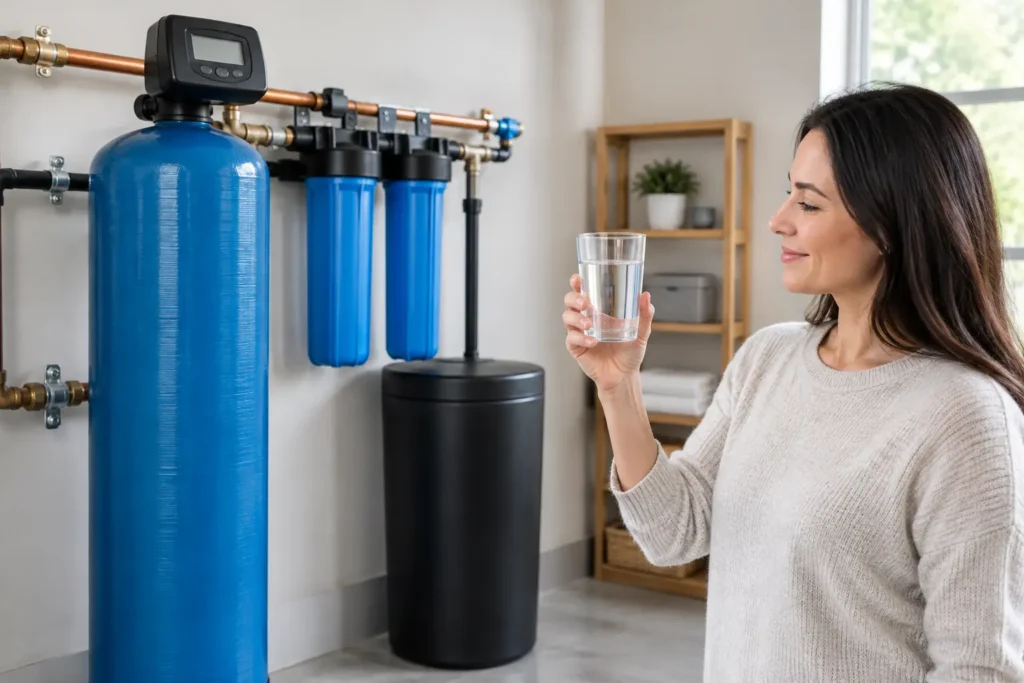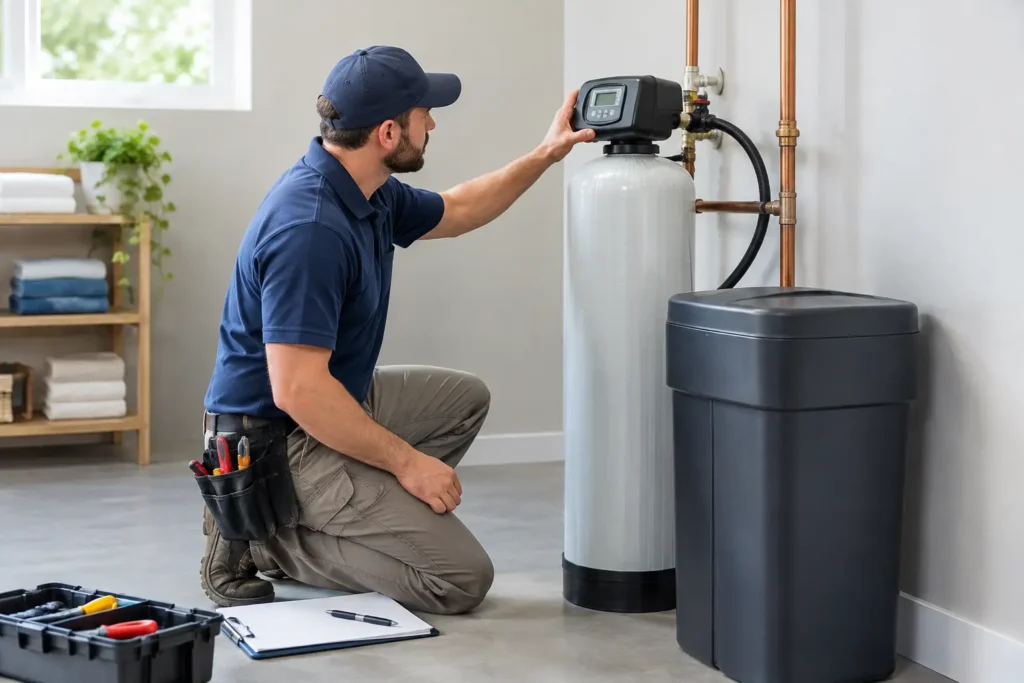


Cloudy water, white mineral deposits around faucets, unpleasant odors, or sediment collecting in plumbing fixtures can leave homeowners wondering whether a whole house water filtration system is the right solution.
For some homes, whole-home filtration can improve water quality and protect plumbing equipment. For others, the real problem may involve hard water, an aging water heater, deteriorated piping, or a treatment system that is no longer operating properly.
The important question is not simply which filter to purchase. It is what is actually causing the water-quality concern and which treatment method is designed to address it.
At Kingdom Based Plumbing Inc., we believe water treatment should begin with understanding the water source, the existing plumbing, and the homeowner’s goals before recommending equipment.
What Is Whole House Water Filtration?
Whole house water filtration treats water as it enters the home’s plumbing system.
Unlike a filter installed at a single kitchen faucet or refrigerator, a properly designed whole-home system can treat water supplied to multiple fixtures and appliances.
Depending on the equipment, whole house filtration may help address:
- Sediment and visible particles.
- Chlorine-related taste and odor.
- Certain chemical compounds identified by testing.
- Specific water-quality concerns for which the equipment is rated.
- Particles that can accumulate in plumbing fixtures or equipment.
However, not every filtration system treats every type of water-quality problem.
A sediment filter does not necessarily remove hardness minerals.
A carbon filter does not automatically correct iron staining.
And a standard whole-house filter should never be assumed to make contaminated water safe to drink without appropriate testing and verified treatment performance.
Signs Your Home May Benefit From Water Filtration
Water-quality concerns can develop gradually or appear suddenly.
Common signs include:
- Visible sediment in faucet aerators.
- Unusual taste or odor.
- Cloudy or discolored water.
- Recurring staining on plumbing fixtures.
- Reduced water flow through clogged filters.
- Particles collecting in appliance inlet screens.
- Changes in water appearance after plumbing work.
Some symptoms indicate a need for filtration, while others may point to a separate plumbing problem.
For example, white mineral buildup is often associated with hard water, which may be better addressed by a water softener.
Rust-colored water could originate from the water supply, plumbing pipes, or water heater.
A professional evaluation helps separate water-treatment concerns from plumbing repairs.
Municipal Water vs. Private Well Water in Northeast Florida
Water-treatment needs vary depending on the property’s water source.
Municipal Water
Homes connected to public water systems receive water that is treated and monitored by their utility.
Homeowners may still consider additional treatment for taste, odor, sediment, hardness, or particular substances identified in water-quality information or testing.
A properly selected filtration system should address a defined concern rather than simply adding equipment.
Private Well Water
Private wells may require a different approach.
Depending on the property, well water can contain iron, manganese, sediment, hardness minerals, sulfur-related compounds, or other substances.
Private well owners should use appropriate water testing to identify treatment needs, including testing for microbial or health-related contaminants when indicated.
A plumbing inspection alone cannot establish whether water is microbiologically safe.
For health-related water concerns, use a qualified laboratory and select treatment equipment with verified performance for the identified contaminants.
Why Water Testing Should Come Before Equipment Selection
Choosing water treatment without understanding the water can lead to disappointing results.
Testing may help identify:
- Water hardness.
- Iron and manganese.
- pH.
- Sediment-related concerns.
- Specific chemical contaminants.
- Microbial concerns when appropriate.
- Other substances relevant to the water source.
The necessary tests depend on the symptoms and whether the concern is aesthetic, operational, or health-related.
Water testing also helps distinguish problems originating from the supply from those developing within the home’s plumbing system.
The goal is to select equipment that addresses the actual issue.
Types of Whole House Water Filtration Systems
Different filtration technologies serve different purposes.
Sediment Filtration
Sediment filters capture particles such as sand, rust debris, and suspended material.
These filters may be used independently or as a preliminary treatment stage before other equipment.
Filter selection depends on particle size, water flow, and the amount of sediment present.
A filter that is too restrictive or poorly maintained can reduce water flow throughout the home.
Activated Carbon Filtration
Activated carbon is commonly used to reduce chlorine-related taste and odor.
Certain carbon systems can also reduce other substances, depending on the media, system design, and applicable performance certification.
Carbon media requires maintenance and eventual replacement.
The equipment should be selected based on the specific treatment goal rather than assuming all carbon filters perform identically.
Specialty Water Treatment
Some water conditions require specialized treatment equipment.
Depending on test results, a property may need a system designed to address iron, manganese, sulfur-related odors, acidity, or another specific concern.
Certain systems use backwashing or regeneration cycles and therefore require appropriate drainage.
Equipment specifications and water test results should guide the recommendation.
Whole House Water Filtration vs. Water Softeners
Water filtration and water softening are related but different services.
A conventional salt-based water softener uses ion exchange to remove hardness minerals such as calcium and magnesium.
Filtration systems are designed to reduce particular particles or substances, depending on the equipment.
A home may benefit from one, the other, or a properly designed combination.
When Water Softening May Be Appropriate
Water softening may be worth considering when testing confirms hardness and the homeowner is experiencing mineral scale, spotting, or hardness-related equipment concerns.
When Filtration May Be Appropriate
Filtration may be appropriate when the concern involves sediment, chlorine taste and odor, or other substances for which a suitable treatment system is available.
When Both May Be Needed
Some properties have multiple water-quality concerns.
For example, sediment may need to be reduced before water reaches other treatment equipment.
The correct order and type of equipment depend on water conditions, flow requirements, and manufacturer specifications.
A larger system is not automatically a better system.
Can Whole House Filtration Protect Plumbing and Water Heaters?
Properly selected treatment equipment can help reduce certain conditions that contribute to plumbing maintenance problems.
Sediment filtration may help prevent particles from accumulating in fixture screens and some downstream equipment.
Water softening can reduce hardness-related scale formation.
However, filtration does not repair deteriorated plumbing or reverse existing equipment damage.
A water heater with a leaking tank, failing heating component, or severe existing scale buildup requires its own evaluation.
Likewise, a clogged faucet or restricted water line may need plumbing repair even after treatment equipment is installed.
Why Proper Filtration System Sizing Matters
Whole-house filtration equipment must be sized for the home’s water demand.
An undersized filter or treatment system can restrict flow when multiple fixtures operate simultaneously.
Sizing considerations include:
- Household water consumption.
- Number of bathrooms and fixtures.
- Expected peak flow demand.
- Incoming water pressure.
- Main water line size.
- Equipment pressure-loss characteristics.
- Water quality and sediment loading.
The goal is to provide effective treatment while maintaining suitable water delivery throughout the property.
A professional plumber should also evaluate whether an existing pressure or flow problem needs correction before installing additional equipment.
Whole House Water Filtration Installation Requirements
Professional installation involves more than connecting a filter housing to the main water line.
Important considerations include:
- Accessible installation location.
- Suitable shutoff valves.
- Bypass or isolation arrangements.
- Proper pipe support.
- Manufacturer-required clearances.
- Equipment protection from damage.
- Drainage for systems that backwash or regenerate.
- Electrical requirements when applicable.
- Access for future filter or media replacement.
A system should remain serviceable after installation.
Poorly placed equipment can make routine maintenance difficult and create unnecessary plumbing problems later.
Drainage and Backwashing Requirements
Not every filtration system requires a drain.
However, certain treatment systems discharge wastewater during backwashing, cleaning, or regeneration.
That discharge must be planned before installation.
The drain arrangement should comply with applicable plumbing requirements and the equipment manufacturer’s instructions.
Where required, an appropriate air gap or other approved separation helps protect the potable water system from contamination.
Discharge should not be directed into landscaping or other areas without evaluating the potential impact and whether the termination is permitted.
A suitable drain connection is an important part of the installation, not an afterthought.
Maintenance Is Essential for Long-Term Performance
Whole house filtration systems require ongoing maintenance.
Depending on the equipment, that may include:
- Replacing sediment cartridges.
- Replacing or servicing carbon media.
- Inspecting housings and connections.
- Monitoring pressure loss.
- Checking bypass and isolation valves.
- Reviewing backwash or regeneration operation.
- Following manufacturer maintenance instructions.
A neglected filter can become restrictive and affect water flow throughout the property.
Homeowners should also monitor for leaks around filter housings, valves, and plumbing connections.
If moisture develops, professional leak detection and plumbing evaluation may be appropriate.
When to Call a Professional Plumber
Consider professional plumbing assistance when:
- You’re planning a new whole-house filtration installation.
- Existing treatment equipment is leaking.
- Water pressure drops after passing through a filter.
- Plumbing modifications are needed.
- Shutoff valves or supply piping are deteriorated.
- A backwashing system requires a suitable drain.
- You’re replacing an older treatment system.
- Water-quality symptoms continue after treatment.
If water is actively leaking and threatening the property, visit our emergency plumbing services page for additional assistance.
For suspected drinking-water contamination, appropriate testing and public-health guidance should accompany any plumbing evaluation.
Whole House Water Filtration in Jacksonville and St. Johns County
Kingdom Based Plumbing Inc. serves homeowners and property owners throughout St. Johns County, Jacksonville, St. Augustine, Ponte Vedra, Nocatee, Fleming Island, and surrounding Northeast Florida communities.
Whether you’re considering whole house water filtration, replacing existing treatment equipment, or addressing a plumbing concern associated with water quality, proper installation begins with understanding the existing system.
Our focus is on professional plumbing workmanship, appropriate connections, clear communication, and practical solutions.
We believe homeowners should understand the equipment requirements and installation scope before work begins.
Schedule a Whole House Filtration Installation Evaluation
A water filtration system should be selected for the actual water-quality concern and installed to work properly with the home’s plumbing.
Before purchasing equipment, consider the water source, relevant test results, household demand, maintenance requirements, and installation location.
Call Kingdom Based Plumbing Inc. at 904-814-8541 to discuss the plumbing requirements for whole house water filtration installation.
Clean work. Proper installation. No shortcuts.