

Hard water can leave its mark throughout a home. White mineral buildup around faucets, cloudy glassware, soap that doesn’t lather well, and scale inside plumbing equipment are common reasons homeowners begin researching water softeners.
If you’re considering a new system, understanding water softener installation cost means looking beyond the equipment itself. The plumbing layout, water quality, system capacity, drainage requirements, and installation location all influence the work involved.
For homeowners in St. Johns County, Jacksonville, St. Augustine, Nocatee, Ponte Vedra, and surrounding Northeast Florida communities, choosing the right system begins with understanding the water and the home’s existing plumbing.
At Kingdom Based Plumbing Inc., we believe in professional installation, clear communication, and planning for the long-term performance of your plumbing system.
What Affects Water Softener Installation Cost?
Water softener installation is not identical from one home to another.
A home with an existing softener loop, accessible piping, a suitable drain, and nearby electrical power may require less modification than a property without those features.
Several factors influence the installation scope.
Water Softener Type and Capacity
Traditional salt-based water softeners use an ion-exchange process to remove hardness minerals such as calcium and magnesium.
These systems generally include a resin tank, brine tank, control valve, and regeneration drain connection.
The appropriate capacity depends on:
- Water hardness levels.
- Household water consumption.
- Number of occupants.
- Expected simultaneous water demand.
- System design and regeneration settings.
An undersized water softener may regenerate too frequently or struggle to meet household demand.
An unnecessarily oversized system may add equipment expense without providing a meaningful advantage.
Proper sizing helps balance performance, salt consumption, water use, and maintenance.
Existing Plumbing and Installation Location
The location of the home’s main water supply affects how a water softener can be connected.
Some homes already have plumbing connections intended for water treatment equipment.
Others require additional piping or modifications to accommodate a new system.
Installation considerations include:
- Access to the main water supply.
- Existing shutoff valves.
- Available space around the equipment.
- Pipe material and condition.
- Location of nearby electrical power.
- Drainage access.
- Space needed for future maintenance.
A water softener should be installed where its components remain accessible for servicing, salt replenishment, and inspection.
Water Softener Drainage Requirements
A conventional water softener periodically regenerates to restore the resin’s ability to remove hardness minerals.
During regeneration, the system discharges wastewater containing the minerals removed during treatment and the brine used in the process.
That wastewater needs an appropriate discharge location.
Depending on the property and applicable plumbing requirements, an installation may require a suitable drain connection, approved air gap, secured discharge piping, or other modifications.
A nearby drain is not automatically an acceptable connection.
The discharge termination should be identified and evaluated before installation begins.
Routing regeneration water directly into landscaping without evaluating the discharge can damage vegetation or create drainage concerns.
Kingdom Based Plumbing believes these details should be discussed before work is authorized, not discovered after the system has been installed.
Electrical Requirements
Many residential water softeners use an electrically powered control valve.
The installation location may need a suitable electrical receptacle within the manufacturer’s permitted arrangement.
If electrical work is required, it should be completed by an appropriately qualified electrician.
Extension cords or improvised electrical connections should not be treated as a permanent installation solution.
Condition of Existing Plumbing
Older or deteriorated plumbing can complicate a water softener installation.
Corroded valves, leaking connections, restricted access, or damaged piping may need attention before the new system can be connected reliably.
A professional plumber should identify those conditions and explain any additional work before proceeding.
Do Northeast Florida Homes Need Water Softeners?
Water quality varies by location, water source, and treatment system.
Some Northeast Florida homeowners notice mineral deposits on plumbing fixtures, spotting on glassware, or buildup in water-using appliances.
However, visible spotting alone does not establish the exact hardness level or prove that a particular treatment system is necessary.
Water testing helps determine whether hardness is the primary concern.
Municipal water and private well water can have different treatment needs.
Well water may also require evaluation for iron, manganese, sediment, sulfur-related odors, or other water-quality concerns.
A water softener is designed primarily to address hardness minerals. It should not be presented as a solution for every water-quality issue.
The appropriate equipment depends on the actual test results and the homeowner’s goals.
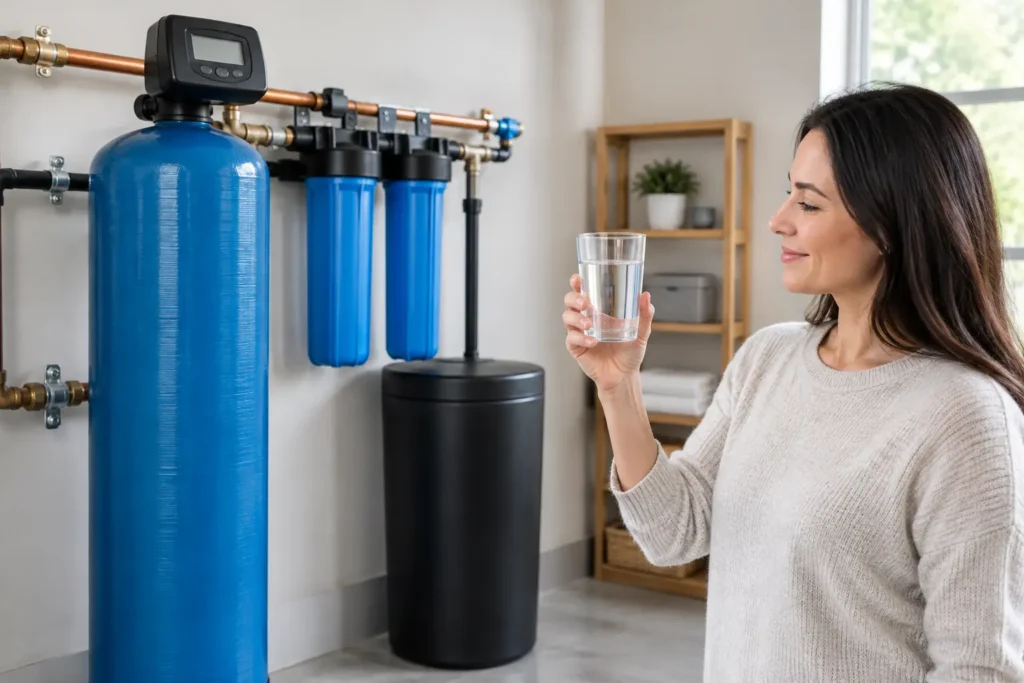
Water Softener vs. Water Filtration: What’s the Difference?
Water softeners and filtration systems serve different purposes.
A conventional water softener removes hardness minerals through ion exchange.
Water filtration equipment may be designed to reduce specific substances, particles, tastes, or odors, depending on the filter media and system certification.
Some properties benefit from a combination of treatment methods.
Salt-Based Water Softeners
Salt-based systems are commonly used when the goal is to reduce water hardness.
They require periodic salt replenishment and an appropriate regeneration drain connection.
Salt-Free Water Conditioners
Some salt-free systems are marketed to reduce scale formation.
However, these systems generally do not remove calcium and magnesium in the same way as conventional ion-exchange softeners.
Homeowners should understand that distinction before purchasing equipment.
Whole-Home Water Filtration
Whole-home filtration systems may target sediment, chlorine-related taste or odor, or other specific water-quality concerns.
Filter selection should be based on the substances being addressed and the equipment’s verified treatment capabilities.
Installing the wrong treatment equipment can leave the original water-quality problem unresolved.
Can Hard Water Affect Water Heaters and Plumbing Fixtures?
Hardness minerals can contribute to scale buildup inside water heaters, faucet components, showerheads, and other plumbing equipment.
As scale accumulates, it can restrict flow through certain components and affect equipment performance.
Tank-style water heaters may develop mineral deposits that contribute to operating noise or maintenance needs.
Tankless water heaters can also be affected by scale in their heat exchangers, depending on water conditions and equipment design.
A properly selected softener can reduce future hardness-related mineral buildup.
However, installing a softener does not automatically remove existing deposits or repair components that have already deteriorated.
If a water heater is experiencing poor performance, unusual noises, or leakage, those symptoms should receive their own professional diagnosis.
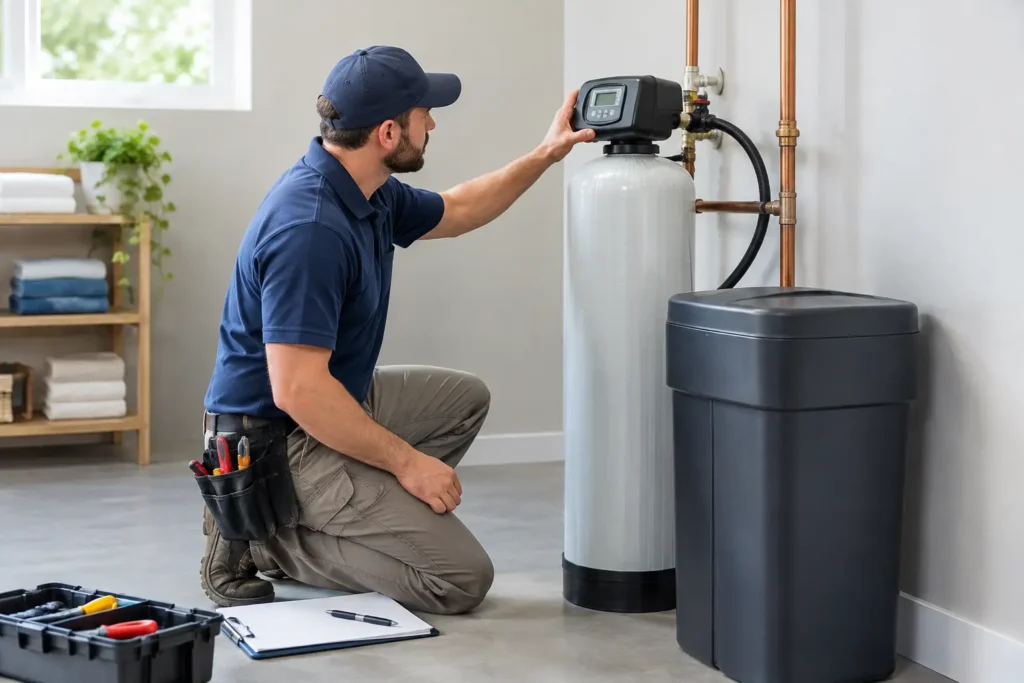
What Is Included in a Professional Water Softener Installation?
The approved scope depends on the equipment and existing plumbing.
A typical installation may involve:
- Reviewing the installation location and equipment requirements.
- Evaluating the existing water supply connections.
- Confirming appropriate equipment placement and service access.
- Installing or connecting suitable shutoff and bypass components.
- Connecting the water softener to the plumbing system.
- Establishing an appropriate regeneration discharge connection.
- Checking accessible connections for leaks.
- Confirming basic system operation and applicable startup requirements.
Programming, testing, additional drain work, and equipment commissioning should be clarified in the agreed scope.
The goal is not simply to connect a tank to a pipe. It is to install the system in a way that supports reliable operation and future maintenance.
Why a Water Softener Bypass Valve Matters
A bypass valve allows water to continue serving the home while the softener is isolated for maintenance or repair.
Without a suitable bypass arrangement, servicing the equipment may require shutting off water to a larger portion of the property.
Accessible, properly installed valves make future service easier and help homeowners manage unexpected equipment problems.
The valve configuration should be compatible with the softener and the plumbing installation.
Replacing an Existing Water Softener
Replacing an older water softener may be more straightforward when the existing plumbing connections are properly located and remain in good condition.
However, existing connections should not automatically be assumed suitable for the new equipment.
Different manufacturers and models may have different inlet and outlet arrangements, bypass assemblies, drain requirements, and installation clearances.
A plumber should evaluate whether the existing plumbing can be reused safely or needs modification.
If an old softener is leaking, malfunctioning, or no longer treating the water effectively, it is also worth determining whether the issue involves equipment failure, maintenance, programming, or changing water conditions.
Can Kingdom Based Plumbing Install a Homeowner-Provided Water Softener?
Homeowners may purchase their own water softener and request professional installation.
Before scheduling, the equipment specifications and installation location should be reviewed to confirm compatibility with the home’s plumbing.
Homeowner-provided equipment should include the required manufacturer components and installation instructions.
Any missing parts, additional piping, unsuitable drainage, or other necessary modifications should be discussed before work proceeds.
Manufacturer equipment warranties remain subject to the manufacturer’s terms.
The homeowner is generally responsible for supplying and maintaining the appropriate salt when required by the system.
Professional installation can help avoid connection problems, but it does not guarantee the performance or condition of equipment supplied by others.
Questions to Ask Before Scheduling Water Softener Installation
Before approving an installation, homeowners should understand:
- Is the selected system appropriately sized?
- Does the installation location provide suitable access?
- Are the existing shutoff valves and pipes in acceptable condition?
- Where will regeneration wastewater discharge?
- Does the installation require an air gap or additional drain piping?
- Is a suitable electrical connection available?
- Are startup and programming included in the approved scope?
- Are removal and disposal of existing equipment included?
- Are any additional plumbing modifications required?
These questions help establish a clear scope and reduce unexpected complications.
Water Softener Installation in Jacksonville and St. Johns County
Kingdom Based Plumbing Inc. provides professional plumbing services throughout St. Johns County and surrounding Northeast Florida communities, including Jacksonville, St. Augustine, Ponte Vedra, Nocatee, and Fleming Island.
Whether you’re replacing an older water softener or planning an installation for the first time, the plumbing connections, equipment location, and discharge arrangement deserve careful consideration.
Our approach is straightforward: evaluate the existing plumbing, explain the available options, and complete authorized work with professional workmanship.
If the project reveals damaged valves or leaking plumbing connections, those concerns should be addressed rather than hidden behind new equipment.
If you’re also experiencing unexplained moisture or water loss, our leak detection services may help identify a separate plumbing concern.
Schedule Water Softener Installation With Kingdom Based Plumbing
A water softener should be selected and installed based on the home’s water conditions, plumbing layout, and long-term service needs.
Proper planning helps avoid unsuitable equipment, poor drainage arrangements, and unnecessary plumbing modifications.
Call Kingdom Based Plumbing Inc. at 904-814-8541 to discuss your water softener installation or replacement needs.
Clean work. Proper installation. No shortcuts.