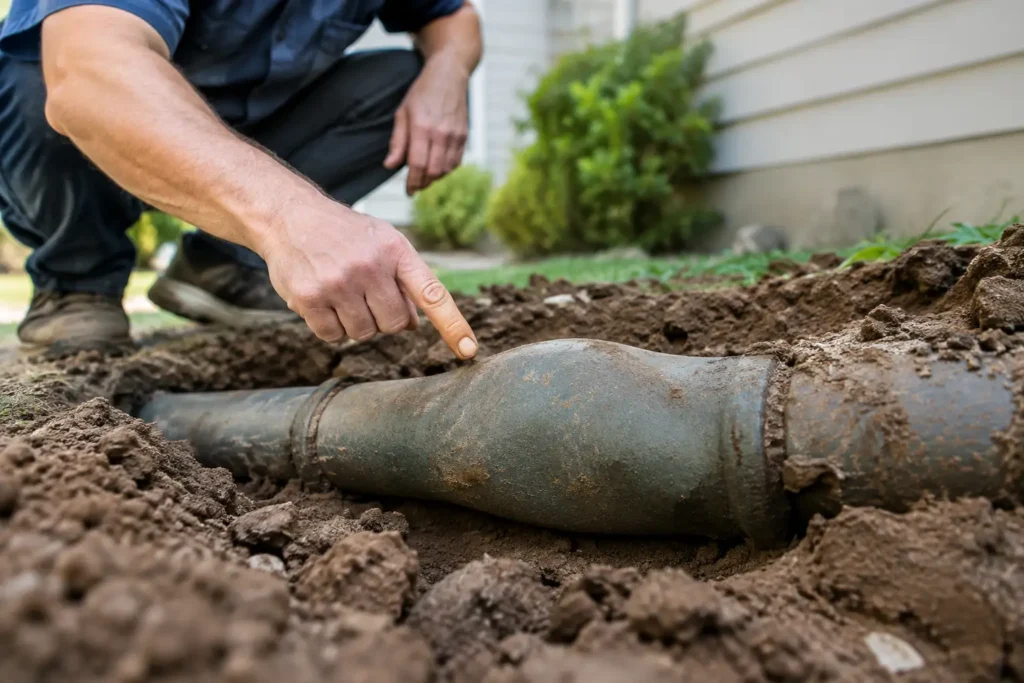


Recurring sewer backups are frustrating, especially when a drain has already been professionally cleaned. If wastewater keeps collecting in the same section of pipe, the problem may be more than a routine blockage.
Recognizing sewer pipe belly warning signs can help homeowners identify a possible underground drainage problem before another backup damages flooring, bathrooms, or landscaping.
A sewer pipe belly is a low or sagging section of underground drain piping. Instead of maintaining a consistent downward slope, part of the pipe dips and holds wastewater.
Over time, toilet paper, waste, and other debris can accumulate in that low area.
The result may be repeated clogs, slow drainage, and sewer backups that return even after cleaning.
For homeowners in Jacksonville, St. Johns County, Nocatee, Ponte Vedra, St. Augustine, and surrounding Northeast Florida communities, a professional sewer evaluation can help determine whether the issue is a simple blockage or a structural problem requiring repair.
At Kingdom Based Plumbing Inc., we focus on identifying the cause of recurring drain problems before recommending the appropriate solution.
What Is a Sewer Pipe Belly?
A sewer pipe belly is a section of drainage piping that has settled or sagged below its intended grade.
Residential sewer lines depend on gravity to move wastewater away from the property.
When a section loses its proper slope, water may remain in the low area instead of draining completely.
How a Sewer Belly Affects Drainage
A properly installed gravity sewer line has a designed slope that allows wastewater and solids to move through the system.
When a belly develops, wastewater can collect inside the pipe.
As solids settle, the line may become increasingly restricted.
A sewer line with a belly can sometimes continue draining for weeks or months before the next blockage occurs.
Is a Sewer Belly the Same as a Broken Pipe?
No.
A sewer belly involves a change in the pipe’s alignment or slope.
A broken pipe involves cracking, separation, collapse, or other structural damage.
Both conditions can exist together, but they require different considerations when planning repairs.
Seven Sewer Pipe Belly Warning Signs
A sewer belly cannot be confirmed by symptoms alone, but certain patterns justify further investigation.
1. Recurring Sewer Line Backups
One of the most common warning signs is a blockage that returns after professional drain cleaning.
Cleaning equipment may remove accumulated waste and restore flow temporarily.
However, it cannot correct a sagging pipe.
When the underlying low area remains, debris can collect again.
2. Multiple Slow Drains
One slow sink may indicate a localized blockage.
When several fixtures drain slowly, the restriction may be farther downstream.
A sewer belly can contribute to reduced drainage capacity when wastewater and solids accumulate in the low section.
3. Gurgling Toilets
A toilet that gurgles when another fixture drains may indicate restricted drainage or a venting problem.
Gurgling does not prove a sewer belly, but it can be a useful diagnostic clue.
4. Water Backing Up Into Showers or Tubs
A main sewer restriction may cause wastewater to appear in lower fixtures.
For example, a shower or bathtub may fill with wastewater when a toilet is flushed or the washing machine drains.
This requires prompt attention.
5. Backups After Heavy Water Use
A compromised sewer line may appear to function during light use but struggle when several fixtures discharge water.
Problems may become noticeable after:
- Multiple showers
- Washing machine cycles
- Repeated toilet flushing
- Heavy household water use
This pattern can occur with several types of sewer restrictions, not only bellies.
6. Sewer Odors
Persistent sewage odors may accompany drainage problems.
However, sewer gas odors can also result from dry traps, damaged piping, or venting defects.
A belly alone does not necessarily allow sewer gas to escape into the home.
7. Standing Water Seen During a Sewer Camera Inspection
A camera inspection may reveal water collecting in a section of the line.
Persistent pooling can be a clue that the pipe has a low area.
However, standing water on camera does not automatically establish the severity, length, or exact grade of a belly.
Additional evaluation may be necessary.
Why Does a Sewer Pipe Develop a Belly?
Several conditions can cause underground sewer piping to lose its intended slope.
Soil Settlement
Soil beneath a sewer line may settle over time.
If the pipe loses support, a low section can develop.
Improper Pipe Bedding
Underground piping requires appropriate support.
Insufficient bedding or improper backfilling can contribute to movement and uneven settlement.
Poor Original Installation
A sewer line installed without proper grade or support may have drainage problems from the beginning.
Ground Movement
Changes in soil conditions, nearby excavation, and other ground disturbances can affect buried piping.
Deteriorated Pipe Connections
Aging or damaged connections may allow sections of piping to shift.
Previous Sewer Repairs
An improperly supported replacement section can develop alignment problems.
Heavy Loads or Construction Activity
Depending on depth and site conditions, construction activity or other loads may contribute to damage or movement.
Are Sewer Bellies Common in Northeast Florida?
Northeast Florida properties can have a range of soil, groundwater, and drainage conditions.
Sandy soils, groundwater conditions, previous excavation, and improper pipe support can affect buried sewer piping.
However, soil type alone does not establish that a sewer belly exists.
The condition of the pipe, installation history, and actual site conditions should guide the diagnosis.
Older homes may also have cast iron, clay, or other sewer materials that warrant evaluation when recurring stoppages occur.
Sewer Pipe Belly vs. Tree Roots vs. Sewer Clog
These conditions can produce similar symptoms.
Sewer problem.
What may be happening: Routine blockage, Waste or debris restricts the line, Sewer pipe belly, A low section holds wastewater and solids, Tree root intrusion, Roots enter through an opening or damaged joint, Offset pipe joint, Connected pipe sections are misaligned, Cracked sewer pipe, Structural damage affects the pipe, Collapsed sewer line, A section has lost structural integrity.
More than one problem may exist in the same line.
A proper diagnosis helps determine whether cleaning alone is sufficient or a repair should be considered.
How Is a Sewer Pipe Belly Diagnosed?
A professional evaluation begins with the history of the problem.
The plumber may ask:
- Which fixtures are backing up?
- How often does the blockage return?
- Has the sewer line been cleaned recently?
- Was a camera inspection performed previously?
- Does the problem occur after heavy water use?
- Are there known repairs or older pipe materials?
These details help identify the most appropriate next diagnostic steps.
Sewer Camera Inspection
A sewer camera allows the plumber to observe the interior of an accessible drain or sewer line.
It may reveal:
- Standing water
- Debris accumulation
- Root intrusion
- Cracks
- Offset joints
- Pipe deterioration
- Possible low sections
The line may need to be cleaned first so the camera can pass through and provide a useful view.
Sewer Line Locating
Electronic locating equipment may help identify the approximate underground position of the camera or suspected problem area.
This can help determine where further evaluation or repair access may be needed.
Evaluating Pipe Grade
A camera can identify suspected pooling and alignment problems, but it does not automatically provide a precise measurement of pipe slope.
Additional locating, elevation measurements, or physical verification may be needed to confirm the grade and develop a repair plan.
A reliable recommendation should be based on the actual pipe condition, not merely the presence of water in one camera image.
Can Drain Cleaning Fix a Sewer Pipe Belly?
Drain cleaning may remove accumulated waste and temporarily restore flow.
However, cleaning does not restore the proper slope of a sagging pipe.
When Cleaning May Help
Cleaning can be appropriate when accumulated debris is restricting drainage.
It may also be necessary before a camera inspection.
Why the Blockage May Return
If the pipe continues holding water and solids, another obstruction may develop.
The frequency depends on the severity of the low area, the amount of wastewater moving through the line, and other conditions.
Is Hydro Jetting a Permanent Repair?
No.
Hydro jetting may remove certain types of buildup when the pipe’s condition allows it.
It does not raise or regrade an underground sewer line.
The suitability of jetting depends on the material and condition of the piping.
Learn more about professional drain cleaning.
How Do You Repair a Sewer Pipe Belly?
The repair depends on the length and severity of the belly, pipe material, depth, access, and surrounding conditions.
Localized Sewer Pipe Replacement
When the low area is limited and surrounding piping is sound, replacing the affected section may be appropriate.
The work generally involves:
- Identifying the affected location
- Evaluating excavation access and utilities
- Exposing the pipe safely
- Removing the compromised section
- Preparing proper pipe support
- Installing replacement piping at the required grade
- Testing and inspecting as applicable
- Backfilling according to appropriate requirements
The exact procedure depends on site conditions and the approved scope.
Replacing a Larger Sewer Section
A larger replacement may make sense when several problems exist along the line.
Examples include:
- Multiple bellies
- Widespread deterioration
- Repeated root intrusion
- Significant joint displacement
- Extensive cracking
- Recurring failures in aging piping
The goal is to address the underlying problem without replacing sound piping unnecessarily.
Does Trenchless Sewer Repair Fix a Belly?
Not automatically.
Some trenchless methods can address certain pipe defects without extensive excavation.
However, methods that follow the existing pipe alignment generally do not correct an improper grade.
A sewer belly may require excavation or another engineered approach that restores suitable slope.
The repair method must be selected based on the actual defect.
Does a Sewer Pipe Belly Always Need Repair?
Not every suspected low area requires immediate excavation.
The decision depends on several factors:
- Severity of the low section
- Whether solids accumulate
- Frequency of backups
- Pipe condition
- Drainage performance
- Accessibility
- Risk of property damage
- Presence of other defects
A small suspected low area in a functioning line may call for further evaluation or monitoring rather than immediate replacement.
A severe belly causing repeated backups may justify corrective work.
The homeowner should understand the evidence supporting the recommendation.
What Happens If You Ignore a Sewer Pipe Belly?
A significant belly can contribute to recurring drainage restrictions.
Possible consequences include:
- Frequent drain cleaning
- Slow wastewater discharge
- Repeated backups
- Sewage entering lower fixtures
- Increased inconvenience
- Property damage during an overflow
- Additional complications when other pipe defects are present
A belly does not automatically mean a pipe is leaking into the soil.
However, if the line also has cracks, separations, or other damage, wastewater may escape outside the pipe.
What Should You Do During a Sewer Backup?
If sewage is backing up into a toilet, shower, bathtub, or floor drain:
- Stop using water throughout the property.
- Avoid flushing toilets.
- Do not run washing machines or dishwashers.
- Keep children and pets away from contaminated areas.
- Avoid contact with sewage.
- Do not use chemical drain cleaners.
- Contact a qualified plumbing professional.
If wastewater is near electrical equipment, avoid the area until it can be evaluated safely.
For urgent problems, visit our emergency plumbing services page.
What Affects Sewer Pipe Belly Repair Cost?
Repair costs depend on the actual condition and location of the piping.
Important factors include:
- Length of the affected section
- Depth of the sewer line
- Pipe material
- Excavation requirements
- Accessibility
- Nearby utilities
- Landscaping
- Concrete or pavement
- Required permits
- Additional pipe defects
- Restoration responsibilities
A localized repair in an accessible yard differs significantly from work beneath a driveway, foundation, or finished area.
A written estimate should explain the approved scope and any anticipated access or restoration requirements.
At Kingdom Based Plumbing, drywall, concrete finishes, landscaping, and other restoration work are separate unless specifically included in the approved estimate.
Unforeseen or concealed conditions requiring additional plumbing work should be discussed and quoted before proceeding.
Can You Prevent a Sewer Pipe Belly?
Not every cause can be prevented.
Soil settlement, original installation conditions, and underground movement may be outside the homeowner’s control.
However, you can reduce avoidable drain restrictions.
Avoid Flushing Wipes
Even wipes labeled flushable can contribute to sewer blockages.
Keep Grease Out of Drains
Grease and cooking oils can accumulate inside piping.
Address Recurring Stoppages
A drain that repeatedly clogs deserves evaluation beyond another temporary clearing.
Protect Underground Sewer Lines
Before major landscaping or excavation, identify underground utilities and plumbing routes as appropriate.
Consider Camera Inspection When Symptoms Repeat
A camera inspection may help identify structural concerns when recurring stoppages suggest more than routine buildup.
Questions to Ask Before Approving Sewer Belly Repair
Before authorizing excavation or pipe replacement, ask:
- What evidence indicates a sewer belly?
- Has the line been cleaned enough for a useful inspection?
- How long is the suspected low section?
- Has the pipe location been identified?
- Is the pipe cracked, offset, or otherwise damaged?
- Can the existing grade be verified?
- Is a localized repair appropriate?
- Are there additional defects elsewhere in the line?
- What permits or inspections apply?
- What excavation and restoration work is included?
- How will the replacement section be supported?
- How will the completed drainage be verified?
These questions help homeowners make informed decisions before committing to underground repairs.
Frequently Asked Questions About Sewer Pipe Bellies
What is a sewer pipe belly?
A sewer pipe belly is a low or sagging section of gravity drain piping that can hold wastewater instead of maintaining the intended downward slope.
What are the warning signs of a sewer belly?
Common clues include recurring backups, multiple slow drains, gurgling toilets, and standing water observed during sewer camera inspection.
Can a sewer belly cause repeated clogs?
Yes. A low section can allow solids to settle and accumulate, contributing to recurring restrictions.
Can a sewer camera detect a belly?
A camera may reveal persistent standing water and a suspected low area. Additional evaluation may be needed to verify the pipe’s grade.
Will snaking fix a sewer belly?
Snaking may clear accumulated debris, but it does not correct the pipe’s slope.
Can hydro jetting repair a sewer belly?
No. Hydro jetting may clean suitable piping but cannot restore the grade of a sagging sewer line.
Does every sewer belly need excavation?
Not necessarily. The severity, drainage performance, history of backups, and pipe condition determine whether corrective work is appropriate.
Can a sewer belly cause sewage to leak underground?
A belly alone does not necessarily cause leakage. Wastewater may escape if the pipe also has cracks, separations, or other defects.
Can trenchless repair correct a sewer belly?
Some trenchless techniques address pipe defects, but methods that preserve the existing alignment generally do not correct improper slope.
Is a sewer belly the same as a sewer collapse?
No. A belly involves a low section or improper grade, while a collapse involves structural failure of the pipe.
How long can a sewer pipe belly go without repair?
There is no universal timeline. Some low areas cause few symptoms, while severe bellies contribute to frequent backups. The actual condition should guide the decision.
Is a sewer pipe belly covered by homeowners insurance?
Coverage depends on the policy, cause of damage, and any applicable endorsements. Homeowners should review their policy and contact their insurer for coverage questions.
Sewer Pipe Belly Inspection and Repair in Jacksonville and St. Johns County
Recurring sewer stoppages should not automatically lead to repeated cleaning without investigating why the problem returns.
Kingdom Based Plumbing Inc. helps homeowners and businesses throughout Jacksonville, St. Johns County, Nocatee, Ponte Vedra, St. Augustine, and surrounding Northeast Florida communities evaluate recurring drain problems and underground sewer concerns.
Whether the issue involves buildup, root intrusion, damaged piping, or a suspected sewer belly, our goal is to identify the cause and explain appropriate cleaning or repair options.
Call Kingdom Based Plumbing at 904-814-8541 to discuss recurring sewer backups or schedule a plumbing evaluation.
24/7 emergency plumbing service available, subject to technician availability.
Clean work. Proper installation. No shortcuts.